Skip to content

Posts from the ‘painting lessons’ Category

Acrylic painting workshops

The first workshop is intended for adults who prefer painting with acrylics and love flowers.

I have quite a few of nice floral reference photos since my fantastic orchids and cyclamens are blossoming every year. It might happen that we will be able to use as models real plants by the time workshop takes place.

Blossoming orchid for painting

Pink orchids look extremely nice when painted, and it does not take too much effort to get done the basic drawing.

Paintings of pink orchid

Pink orchid is a great choice for floral workshop even for artists who have a fairly small experience because:

these blooms have a very easy to capture gorgeous, gracious shape;

it is not complicated to vary and mix up the most distinctive pink shades;

we have multiple choices for backgrounds, including:

smoky grays and blues;

bright or dark blues;

green shades or aqua blues;

purple shades + greens and blues;

warm ocher and sap green + burnt sienna and burnt umber shades.

Any of these backgrounds would make a fantastic painting.

Pink orchid on light background

It is also possible to implement in the painting as many or as few blooms as we wish.

Painting pink orchid

I will offer cyclamen images to artists who would rather paint these fabulous flowers.

Painting pink cyclamen

The color choice for blooms and background will be similar, we will just do a different drawing.

Painting cyclamen

The horizontal versions would look as good as the vertical ones.

The size of canvas for these 2 day workshops should not exceed 20 x 18 in.

I would not recommend to go with much smaller canvas, as well, because painting tiny objects is tedious.

You should have 1 flat brush for acrylic painting (about 1 – 1.5 in) and 2 round brushes with fine tips, 8-12 in size. Please do not take with you brushes for oil painting.

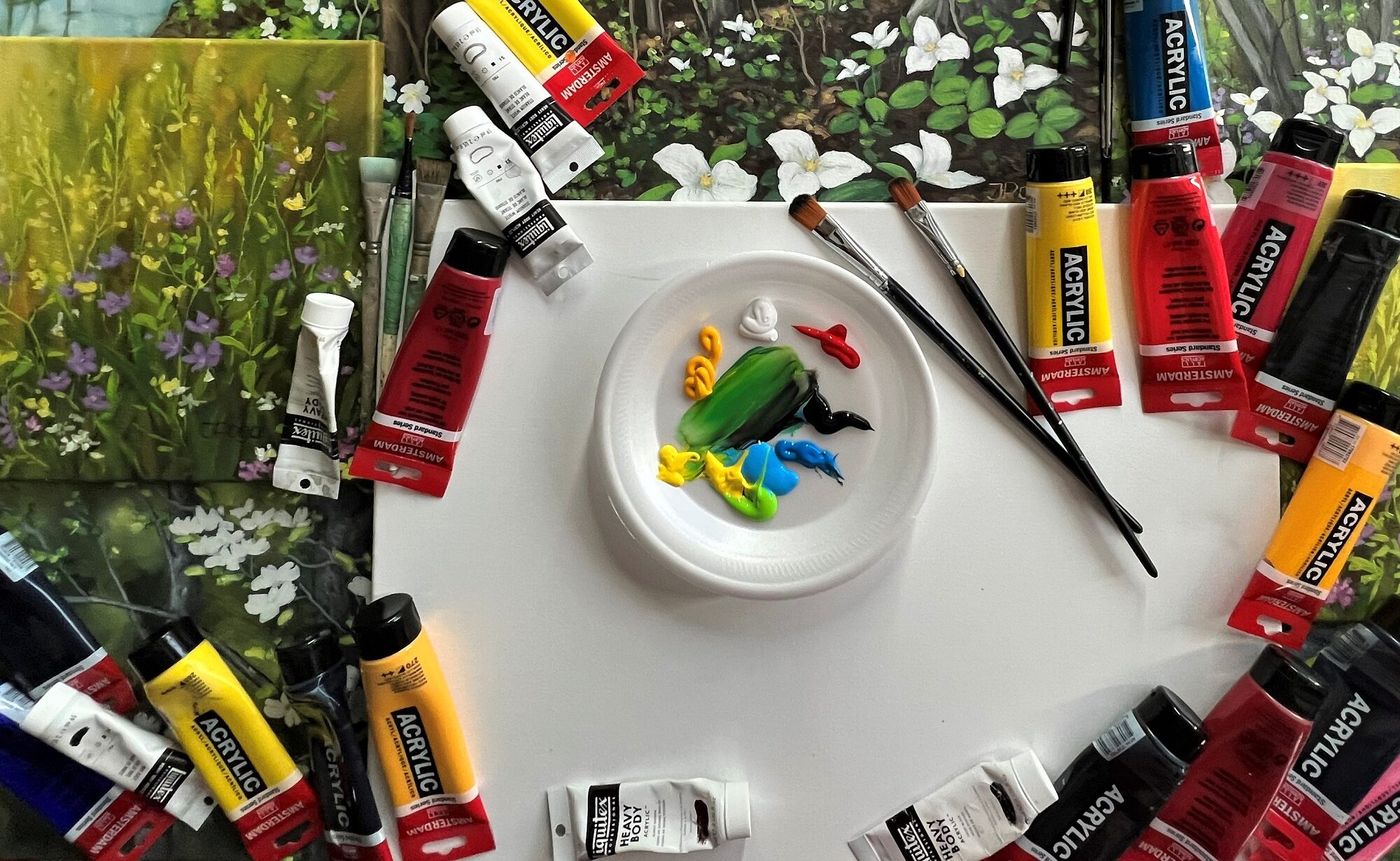
The paints we are using for similar paintings include:

Payne’s gray, titanium white, primary magenta, quinacridone red or quinacridone crimson, cadmium yellow medium and cadmium yellow light, burnt umber, burnt sienna, yellow oxide and yellow ochre, ultramarine and cobalt blue, green gold, brilliant yellow green and sap green.

You do not need all colors. You obviously can narrow down the number of paints depending on background which you would rather choose.

This workshop will take place on:

January 27th: Day 1: 1 pm to 4.30 pm

February 3rd: Day 2: 1 pm to 4.30 pm

The second workshop is scheduled for:
February 24th: spring scene with trees, Day 1
March 3rd: spring scene with trees, Day 2
We are painting for 3.5 hours every day, or for 7 hours in total.
Since materials include a preliminary sketch (you can do your own sketch, as well), the spring scene painting should be done by the end of day 2.

The basic image captures warm, sunny spring scene with trees.
Spring landscape with trees, textured acrylic painting 30 x 24 in

Students who love adding detail for more definition in their paintings will be able to use additional images.
We will work combining all images and implementing as much or as little in our paintings as we like.

Every artist can make his/her own color choices. This means you could go for more contrast using blue and yellowish/ochre shades, or use more purple/red shades in the front part, or any other suitable combinations you prefer.

Large trilliums in forest
Please contact me if you are not sure what paints to get/use for this painting.

I will publish pictures of drawings, half-way paintings and finished paintings with details for those who are following our progress online.

Happy painting!

Christmas Show and Sale: Art, Crafts, Gifts

It’s Christmas time again, and we are having our annual Christmas sale. It is richer and more interesting than ever before. I have no doubt, everyone can find something great, whether it’s a Christmas decoration, nice, hearty, one of a kind gift, painting, card or gift certificate. Gift certificates for classes and workshops are available every day, not only during the sale.

You can enjoy and possibly purchase more than 200 paintings and crafted gift items.

All decorations and gifts are crafted in the gallery and range in style from traditional to modern and trendy, both, regarding the color scheme and design. We have used mostly nature materials: fir and pine cones, apple-tree and maple branches, fir- tree branches and also some paints, glitter, tissue paper and interesting containers. You should definitely check out the one of a kind gift boxes, note books, diaries and photo albums.

We are offering only original paintings and art, including three-dimensional acrylic nature paintings in subtle and soothing colors.

Variety of Christmas cards can be ordered from the Fine Art America site: http://inese-poga.artistwebsites.com

Please have a look at some gifts and decorations for sale.

Traditional Christmas colors

Traditional Christmas colors

Crafted Christmas gift boxes

Crafted Christmas gift boxes

IMG_5173

Traditional Christmas decoration

IMG_5178

Gold and red

Roses and pine-cones

Roses and pine cones: they make nice Christmas decoration

Red and green: Christmas gift

Red and green: tissue paper roses and glitter on branches

Christmas gift box and red roses

Christmas gift box, very elegant and delicate, matches the Christmas center-piece very well

Christmas decoration in white and gold

Stylish Christmas decoration in white and gold

Set of Christmas decorations

Set of Christmas decorations: bottles are getting new life, and they look amazingly attractive together with the basket

Adding some other decoration

Gentle and relaxing Christmas colors

Christmas light

This set will bring the Christmas mood in your home

Celebrating the light and warmth

White and red: Christmas gift boxes

Festive and uplifting

IMG_5262 Notebook with white roses for Christmas

Notebook with white roses for Christmas

Sparkle and shine: Christmas settings

Sparkle and shine: Christmas settings

Notebook with golden roses for Christmas

Notebook with golden roses for Christmas

I hope you enjoyed the decorating ideas!

Fall Art Festival at Camp Samac: Friday

I belong to people who have lots of duties, responsibilities, appointments, arrangements, etc. I am always planning ahead, but I often find myself balancing on knife-edge to meet all deadlines and to make all things happen. Generally speaking, I cannot avoid some rush with whatever I’m trying to do. Getting ready for art shows always involves some frantic adding of last strokes to some time ago created paintings, some sudden new painting idea just the night before the show; and, yes, that’s me typing the art sales sheets and printing labels just half an hour before I leave to set up the show.

This is how it looks at 10pm the night before the art show. I need my watercolors for signatures and small corrections, I need acrylics for adding some highlights or freshening up the lost darks. I need everything to be right there and all around. What a mess, really! However, this photo was taken before I started to do all of these adjustments. It looked much messier at 1 am when I decided to leave everything alone and get some sleep.

These paintings are waiting far labels, they are also getting checked for imperfections or missing signatures.

This is such a happy moment when the provided space is set up. It seems like nothing to it, and I really have to wonder, how could it take so incredibly much time and efforts?

I decided to do mostly trees this year, and when I stopped by, I found out that 3 paintings were already sold. Great news.

Why trees? I find them extremely human, having so much of character which people are often lacking. I don’t think there can be ever painted too many trees or flowers, these silent guards of our living space.

Autumn birch painting

Birches are stubbornly maintaining their white coats regardless of seasons. It’s not surprising they have found reflection in so many poems, paintings and stories. How to stay white is the lesson they teach.

Gold and silver is a good match: birch trail painting in acrylic.

Shy, but strong: late autumn birch acrylic painting which was sold right away.

We can respect maples for knowing how to lose their beauty in such a gracious and marvellous way, there are no regrets, just sadness for rapidly disappearing magnificence.

This maple road painting was done in my rich acrylic texture technique. Paintings of this type change colors as the surrounding light does, and depending on the viewing angle, foliage feels almost touchable at some moments. This painting was also sold straight after I put it out. These paintings exist only as single originals since no prints or similar reproductions can be made, and that’s what I like about them.

Materials for watercolor painting classes

I am receiving lots of phone calls and plenty of e-mails from potential students these days. In order to avoid answering everybody separately, I decided to post some pictures showing art supplies which we are most often using in our painting and drawing classes.

Watercolor painting supplies

You can use watercolor pencils, watercolor paints in tubes or set of pan watercolors when starting out. You do not have to buy everything right away, but small set or some paint tubes are necessary for the first class.

Student grade paints will not have the same properties as artist grade paints because they contain more fillers and less pigment. There is still always something in between: not too expensive and having acceptable quality. However, it is better you get only a few tubes of excellent paint than 20 tubes or large set of bad quality paint.

It is also important to have a good watercolor paper because your painting results will directly depend on quality of paper and paint. We are using thick, rough or fairly heavy, thick, cold press watercolor paper. Not all brands will have the “ROUGH” paper, but all of them offer “COLD PRESS” paper. Please pay attention that we are using only cold press paper (it is written straight on a block of paper). The thickness of watercolor paper is measured by weight. So, the greater the weight, the thicker the paper. It is measured either in pounds per ream (lb) or grams per square meter (gsm). I would recommend, you look for paper which weighs at least 140 lb (300 gsm). The heavier papers are very expensive, so choose something from the medium range.

Poor quality paper will buckle, warp and it will not allow to use some painting techniques because the number of washes is very limited on thin paper. Masking fluid can cause it to tear.

The size of your watercolor paper actually matters. It happens very often that beginners choose paper of a very small size. It is a wrong assumption that painting tiny stuff is easier. The smallest size you should go for is approximately 9 x 12 in, and 11 x 15 in paper works really well with most of our painting techniques and themes.

To paint comfortably, you will need to attach your paper to some firm, but light base. Firm cardboard or something similar is fine. The base should exceed the painting paper size, and some artist’s or painter’s tape will be needed, as well.

We are using some medium and medium-large size brushes. The numbers vary between brands and manufacturers, and not everybody knows where to look for them; just make sure you buy fairly large brushes with soft bristles for watercolor. We are usually fine with one flat brush (at least 1 in wide) and one or two round brushes with fine tips.

When painting with watercolor, it is highly recommended to use well absorbing paper towel. Paper towel is necessary for cleaning the brush, taking off extra paint or water and correcting your painting.

Palette can be very simple, just watch out that you do not get something tiny since it is extremely difficult to mix up reasonable amounts of paint in something which is size of a quarter. If you think, you’d rather save the paint which is already on your palette, get some medium size palette with lid, that way you won’t have to dispose any paint, as long as it’s not dirty.

These are watercolor pencils. It is possible to achieve excellent results using these pencils either for the entire painting, or only for its initial stages.

It is better to buy watercolor painting supplies in a specialized art store, I do not think Wallmart is an option for paper, brushes or paint, but you could get paper towel, painter’s tape, palette and base for attaching your painting there.

Raising the bar and achiewing excellent results

I find that an art class is successful when everything comes together: students are patient and willing to learn, and instruction is kept individual and provided step-by step.

Amazing what can be created within some 5 hours or 2-3 classes

My huge experience also shows that theory is fine, but should be provided on “as we go” basis. It is also important that the instructor is able to teach. You might remember from your school years that there were great teachers and not that great ones. It is not enough that teacher has huge knowledge and skills on his/her own, it is critically important that teacher has ability to deliver such knowledge, skills and approaches to students, keeping classes interesting, exciting and rich in content at the same time.

Making time for getting the painting done

Potential students should always have a look at their art teacher’s work: is this something you would like to be able to create, is this something which inspires you? An artist who is very good in drawing and painting realistic plein air landscapes, most likely won’t teach abstracts or cartooning. The basic approach should match your goals or intentions. Every student develops his/her very own style quite soon, and we all have our favorite colours, objects and themes. However, it is not that important whether you start out with drawing jars, cups, apples, tomatoes or flowers. Principles, techniques and how-to knowledge is important. Once you have mastered that, you will obviously turn to themes and objects, you prefer.

One more thing we are emphasizing: whatever you are doing, do it with confidence. Confidence is very crucial. That’s why thinking is an inevitable part of painting. Before you put down your brush with paint on canvas, you should know, why and where it is going. You should decide what colour goes where, what highlights will be applied to what spot. This is called: applying the paint with confidence.

An art class is shorter, a workshop is longer. My workshops always involve demonstrations and step-by-step instruction. Even though, I’m limited in time, I would give some demonstrations during my art classes, as well. This doesn’t mean painting the entire image, but rather some parts and segments of it. I find, this helps students tremendously in order to decide how they will proceed.

Clouds demonstration, painting in progress

First things first: working on background

I will publish more specific tips for starting out with watercolour and acrylic painting in some of my next posts.

Check this out: Results speak for themselves

I’m very proud that all students have found my classes very useful and exciting so far. They admit, they have learned something new and improved their skills every time they attended my studio-gallery classes.

Most students were absolute beginners, some of them were having art classes at school before. It is great experience to watch my students progressing so fast and developing nice technical and surprising creative approach.

My studio-gallery is a place which really inspires, it also has increadibly artistic atmosphere. I have learned patience working as a high school teacher back in Europe for many years, and I also happen to have profound methodical and theoretical background along with practical drawing and painting skills.


We usually start with creation of a pencil sketch.

Drawing flowers and different still life objects develops the specific visual qualities which are very important for an artist, especially in early stages. Students elaborate skills of being able to capture real 3-dimensional objects at first; it’s their own choice later whether they reproduce photos, or continue painting and drawing the real stuff.

We are doing not only floral paintings, but it comes to us very natural to engage in floral art during springtime.

These are just the first steps. Some students like the drawing part more, some prefer application of paint and color.

Whatever we would paint, we usually have to decide on colour palette which will be applied in painting as we go. It is great to implement unexpected effects (positive accidents) when some paint splashes occur exactly on that spot where they were needed.

I paint along with my students and provide demonstrations as we go. This includes small corrections or new approaches, anything, which helps to reveal the chosen object.

This is almost done, Jerica with her painting.

Everybody is busy

Spring daffodils

Kristina comes from an artistic family,  visual art and music is something her family genuinely appreciates, and she  always says such a warm “Thank you so much!” after the class, that I cannot express how good that feels.

Sketching is an important preparation step. In my opinion, being able to draw allows an artist to emply so many opportunities. If there were no cameras or computers all of a sudden, drawing would still allow to capture any scene or object as good as photography, if not much better; because there would be nothing between vision and perception of the artist. Research suggests that our visual abilities are very unique, just like our finger prints. This means there’s no other person who sees the same thing exactly as you do.

This is Diana’s sketch. She is very careful and increadibly patient, and results are great.

Spring crocuses: Diana’s painting

Diana has been attending my art classes every single week since July 2011, and she has decided to go to an art school.

Jerica’s Easter lilies

Another version using the same drawing as a base

I think, art classes keep student busy, develop unique mental and visual perception, allow to obtain new skills, and they are fun, as well. Besides, students create impressive paintings which can be framed or varnished for use without any frame, and that way, they can already decorate their house, give their painting as a gift, or even sell it. Some students have sold their paintings.

I am participating in Oshawa Art Association Spring Studio Tour which takes place on May 5 and 6 between 10am- 4 pm.

Everybody, interested in art, is very welcome to attend my studio-gallery and get the tour brochure and list of all included artists. I will post additional OAA Spring Tour info next week.

Wake up and get in mood for spring

This slideshow requires JavaScript.

Living in more and more civilized world, we are loosing our ties with nature and seasonal cycles. Light and sunshine are very important factors which can tremendously facililate our energetic resource regeneration and our recreation, but lack of these essential elements causes inevitable destruction and death of anything organic and alive.

Lux aeterna – the eternal light, is the light in its highest meaning, light as a symbol of timeless flourishing and development.

I don’t think, it’s coincidence that “luxury” and Latin “lux” (light) have the same linguistic root. And, yes, the sunlight is a luxury which we are taking for granted.

Animals and plants are more involved in natural processes, and, no wonder, they thrive and bloom, and are at their energetic top-levels in spring. I suppose, humans were pretty much the same, but the artificial surroundings, which allow us to imitate any season and, thus, facilitate our functions regardless of the weather, don’t require us to feel and understand nature any more. Most of us have our shelters, and who actually cares, how long it’s going to rain or snow.

However, those of us who have still maintained the extraordinary sensitivity to underlying processes of nature, would probably agree that spring has not lost its importance as a driving force of the new seasonal cycle.

Nature wakes up, live juices start to circulate in trunks of trees, grasses and weeds lift up their tiny heads, buds are getting bigger and bigger with every second, first blossoms show their faces to the sun, and birds give the best concert of the year, especially when the day is bright and sunny.

Well, it’s really the right time for new initiatives, new challenges and wake-up activities. This is the renaissance time of our town, city, area, land, country, hemisphere. This is such a breathtaking renewal of our mind and soul, and our body shouldn’t be left behind.

We are welcoming the return of spring with our colourful floral paintings in my studio-gallery, and I will show  in my next post how we are drawing and painting these artworks.

Fall art classes and registration

New students can apply for art classes and register for fall-winter session.

Art class lasts 1.5 hours. We usually start out with sketching and drawing. Once the drawing is transferred onto paper/canvas, students continue with watercolour pencils, watercolours, acrylics, or pastels.

I am teaching still life, florals and landscapes. Please see my website for style.

My goal is to teach students to discover the excitement of drawing and painting real fruits, vegetables, flowers, street scenes, nature scenes without re-producing photos, computer printouts and means alike. The creation is a genuinely original art since it originates in artist’s imagination and view.

Most students are beginners or with very limited experience, but everyone has shown remarkable results so far. There will be a group for students with previous experience in painting and drawing.

Classes are designed for children from 10 years, youth and adults.

Please e-mail me for available days/day times because they will depend on the medium of your choice.


Follow

Get every new post delivered to your Inbox.

Join 157 other followers

%d bloggers like this: