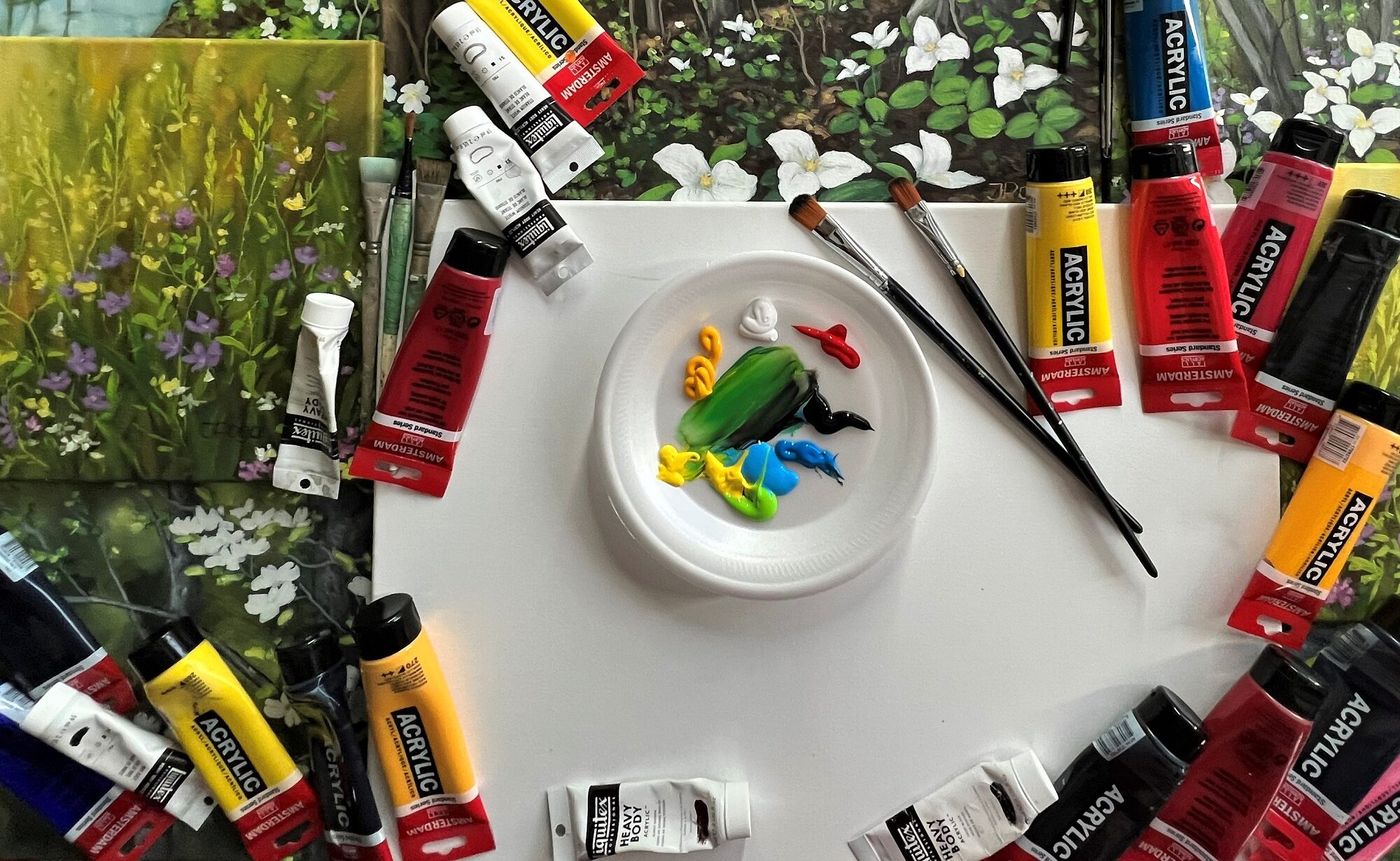
Art projects for art classes and paintings for a show: they are very different by nature, subject and size. Time is of essence since one can attend only that many art classes usually (I always hope they’d come back for more!) and an art class needs to be of certain length. After holding extremely many of them, I’ve stayed with roughly two academic hours or 1.5 hours. There is a reason for that. The attention span can stretch only that long, and to create something good, we absolutely need to be attentive, focused and alert.
For show art projects, I’d definitely choose a much larger canvas size, as well as maybe more tricky, more complex and more intriguing subject which my students who can be almost or practically beginners would not be able to paint. The painting process itself is not the same also: I work on the entire painting and not with a few colors or on a few areas. My attention goes to any spot which requires it and I obviously do not follow special steps, but rather my idea and its implementation. All attached images are 20 x 116 in or 51 x 41 cm in size.
Over time, one learns how to apply paint automatically, how to clean brush automatically and very frequently, as well as how not to skip the messy stage of acrylic painting which can look quite horrible at times. Brushstroke is one of the most important parts of the painting process. When somebody starts out, they just don’t have it yet. If you still remember how you learned to write manually, you know that the hand cannot follow what the brain tells it to. The other sensitive issue is that if you have experience, you never start acrylic painting with the final color and layer. You build color, build your subject, all shapes and color transitions starting with dark and moving up. Our art projects allow practicing all of that.
To cheat the visual perception easier, as well as to have at least one good base layer on what to build the rest on, I do ask my students using pre-painted canvas only. Yet, still people are so afraid of dark colors that the pre-painted canvas is way too light. Without strong base, there is nothing much of a painting. We can all move paint around, even to the point when it becomes muddy brown-grey, but to get on that canvas some impression and some mood, takes much more than that.
Since everybody paints abstracts and there’s no clear understanding what’s a good abstract and what’s just a colored canvas, I stick to my personalized realism. It definitely allows implementing my own features and apply something which others do not. Therefore, my art projects include some of realistic features. While having texture layer on canvas attracts lots of attention let’s say at a show, it can look not good on photos because the high spots catch more light which doesn’t always correspond to light areas on the painting.
The attached images were initially painted between 10-5 years ago. The subject of these art projects is what we liked back then: barns, roads, fall colors, something not too complex, but bright and vivid. The current acrylic class deals with slightly more sophisticated acrylic art projects. We’ve just had one class by now and the start looks promising. The group is tiny as in COVID era, so no problem treating everyone very individually. They are still very good paintings, the ones which took the first brushstroke long time ago, and I will hang them in the studio room where I can put art on the wall because I cannot do that everywhere. Well, I rent, and that comes with requirements.
Enjoy! What better time to immerse oneself in color than now?
The lifting morning fog is the most recent addition to my art collection. Birch trees have always been a favorite for autumn paintings, especially, when I have a few students who want to learn painting fall colors. The classic involves an artwork which we started in 2018, and it got not finished until now. Half-done paintings sort of nag and urge me to not be lazy and just add a few layers of paint.
Every day is only worth what its accomplishments are. I believe every day is good when I can show something for it. Therefore, time I devote to each artwork feels as a well-spent day. While everything else is rather slow and inconclusive in our life at the moment, one aspect of it is always unchanging: the creative aspect and pleasure of creation.
Acrylic paints dry darker, that’s why we need to learn what color combination is suitable for background, middle and foreground. I’ve talked a lot before that applying color is not the same as building it up. Building up color creates volume and color shifts, as well as allows implementing color temperature.
Textured birch trees on bright forest ground takes its origin probably in 2015 if I am recalling this correctly. I apply textures on canvas which is painted in the base color, grey or brown usually. I cannot judge yet whether it will become a good painting or not, therefore, many layers of paint are required to make it work.
Textured paintings are more problematic to photograph because the textures are raised and reflect more light. Color play is important part of textured paintings, but it comes to full expression seeing the art in person.
Here is the Rusty gold of autumn birch: it’s the same painting, compare with the image below; but pictures show completely different background colors. Unfortunately, neither one is absolutely true. The actual painting isn’t yellow, and the background isn’t bright blue, but the options are either to publish or not, and I would most often choose to publish. Rusty gold of autumn birch painting is 24 x 20 in or 61 x 51 cm.
I started to paint the lifting morning fog at the beginning of August. I had a very diligent student who attended private classes, and she was interested in fine detail of acrylic painting, layering colors and achieving a certain grade of realism. Nobody without experience can just jump in such art right away with the first brushstrokes. We managed, but such art takes much longer than a few hours. In my case, it’s rather a few weeks.
The lifting morning fog painting is created on my favorite size canvas: 24 x 18 in or 61 x 46 cm. I love this size for both, watercolor and acrylic.
Pictures were taken with iPhone, and that sometimes adds way too much contrast and changes the color temperature. Colors usually on pictures are either stronger or weaker, but not my actual colors. My experience is that grey becomes strong blue and that disturbs color balance of my artwork. I’m using a grey-bluish shade which is carefully crafted, unfortunately, it looks very blue on the images.
I hope you like the new additions to my art collection, and some will also be put up for sale soon. Currently, there are quite a lot of acrylic paintings, and I update the sale pages quite frequently. Stay in touch and all the best enjoying the October colors!
Like every year, we get from winter into summer heat in Ontario. I’ve noticed there’s nothing in the middle quite often. It was cold even until the first weeks of May, and then suddenly, we got high heat. That means plants and flowers bloom over in a few days, and everything at once. It is difficult not to take part in all breathtaking blooming and return to life of nature, therefore, I am feeling as if in summer in my art already. The old story: creation must be done in advance of any seasons, celebrations and festivities.
Not only for shows
It’s not so that I am creating only complex art for competing in shows and simple art for teaching art classes. One of the other categories would be plainly decorative art, and we are seeing lots of it recently. Just some splash of color, some shapes or basic subject on white or abstract background. Nothing extreme, nothing mysterious or hiding deep meanings, just art for covering wall space and keeping the creative hand sensitive. This is the routine art which doesn’t reach ceiling of mastery and doesn’t strongly affect our mind or soul. Art that is often described as “lovely, nice, cute”. These are, besides, the worst compliments when it comes to creativity and creation. They say practically nothing, they are empty words. They leave one unaffected like water drop rolling down a leaf leaving no trace as it evaporates.
Summer cottage
Technical side versus emotional aspect in painting
t’s understandable that with overload of images the internet viewer is attacked with in a split second, nothing gets more than a quick glance. Rarely, somebody will notice elegance of lines, flowing or strong brushstrokes, shifts of warm color into cool shades, perspective, mood, the way the subject reveals itself, I mean, all things which exceed just purely technical approach of painting. Technical approach dominates because lots of art on the internet is done by beginners and emotional level is left out when the main focus goes to the technical side of using art supplies and creating the subject.
Mastery in art
The most adorable category is art as discovery, art as secret, art as mystery and soul touching art. Not every artwork becomes a masterwork, far from that. Even well-known artists have uneven level of mastery in their works, and that is just a very human feature. Nobody can be at the top of their creative juices and riding the wave of inspiration 24/7. Any human has ups and downs, divine moments and dark alleys where they get lost. It is a good personal goal to have more of good art which has lasting effect on the viewer. Every artist tries to achieve that, and in the best artworks, mastery comes to expression.
Show continues
The virtual art show continues, and since the lead post was helping a little, but I need to add new art, I am including in this post variety of available images, the brand-new blooming meadows paintings and some other art. I know how nobody wants to see more sales and so on, but I simply need to turn visitors’ attention to the fact that these are show artworks and they are currently sold at their best prices. I will probably change the content after a while, but for now, please enjoy, and you might possibly like to purchase some art.
Representational art and my transition to personalized realism
To me personally, creating art means observing and creating it without help of any devices, and where possible, using the real things as references. It also means drawing and painting the subject in a recognizable way, but not necessary sticking to life-likeness so tightly that I cannot implement my own adjustments which are not present in reality. Representational art is pretty much neglected and not recognized in Canada. The modernism and contemporary traditions run here deep, and, certainly, artists who engage in abstract and contemporary abstract art, are way better off.
Flooding spring water, watercolor, 42 x 18 in or 61 x 46 cm.
So, how come I prefer realism in art?
First of all, my background is very different from Canada-born artist’s background. I moved over here when I was close to 50. By that age, the local Canadian artists have established their niche, gotten decent visibility and have participated in numerous juried and other shows. Well, I had with me 2 brushes and a travel set of watercolor paints, and that’s it. No portfolio, no previous paintings because you just don’t have space in one suitcase. I hadn’t even ever had a camera before I arrived here, therefore, I had no images also. So, I started from scratch. I’ve been very successful and productive comparatively, but I certainly couldn’t catch up in a few years with what others had done during quite many decades.
Country barn in spring landscape, size of this painting is 22 x 16 in or 56 x 41 cm
Talent and practice
I had some features which lots of artists do not have when they start out, even if it is at quite old age. I was drawing since early childhood, all on my own. Unlike in North America where somebody would immediately get a private tutor for talented kid or send this kid to a specialized school, nobody gave anything about my well-done drawings. I didn’t have any artists around, moreover, I had never seen any real art. We didn’t have TV those times, nobody had even dreamt about internet back then. It was a countryside out of a small picturesque Latvian town where we lived, but there were no museums, no exhibitions. I had the feeling that I can draw, and my goal was to create drawings so that the things on them looked real.
Country barn, spring, pen and watercolor, 16 x 12 in or 41 x 30.5 cm
Self-criticism
I was very critical and paid attention to every flaw in my drawings since there was nobody else to provide with critique, explanation or suggestion. I practiced for numerous hours until my drawings looked good to me. The paper I had wasn’t a drawing paper, nothing like it. It could be wrapping paper, white pages in front of a book, some paper for notes and later notebooks for school. I was certainly not selective when it came to art supplies, I simply didn’t have them, but pencils were around. I didn’t have eraser, therefore, I learned to draw without necessity to use an eraser.
Old countryside house in pen and watercolor, 18 x 12 in or 46 x 30.5 cm
Rocks and water, size of painting is 22 x 15 in or 56 x 38 cm.
Big works for me
I always loved drawing big or as big as I could depending on paper size. In high school, I was drawing life-size figures, huge posters. Well, Latvia was still in the Soviet Union, you couldn’t just go out and get a photo of a musician or modern poster because there weren’t any. I filled this gap and my paintings and drawings were very popular. I added to my stipendium during the University years (government paid students who had excellent results) income from drawing portraits of fellow students. It was a decent extra income which I immediately spent in old and rare book store. That explains why I do not draw and paint portraits while in Canada: I always did it from a real person, not photography.
Peaceful, lake view, watercolor, size is 20 x 16 in or 51 x 41 cm
My favorite subjects
We always had a garden and orchard ever since I can remember me. After helping my parents with most urgent work (we always had to work as soon as we were able to, like 5 or 6, and it was due to necessity of life, not my parents’ dictatorship), I sat down in front of some building, in a park or next to a flower or plant in the garden and just drew and drew for countless hours. When the drawing had all decent values, contrast and proportions, I was genuinely happy. I called my lines “completed lines”. If there was something not fitting in or sticking out, I started over. I developed my own style eventually since I had zero outside influence. Zero, and it’s a good thing. Although, I couldn’t study at art academy, I never gave up art and always kept it close to me.
While anemone forest, spring painting, 24 x 18″
Canada got me going on watercolors
The first paintings I did upon my arrival to Canada were all full sheet watercolor paintings: 30 x 23 in or 76 x 58 cm. This was the first time I ever had a real watercolor paper. It was Arches, 300 lb or 640 gsm. It felt like wood, and I loved it. Its cost was about 10 times less what it is now, and, yes, I used it for everything, even color tests. I was wondering how could the American and some Canadian artists get so much detail in their paintings because, realistically, what I cannot see, I cannot paint. This was the first time also when I discovered that artists were repainting photos, too. That was new since I was always told that repainting a photo is the worst of artistic sins.
Early spring, rural hills watercolor, size of this painting is 24 x 18 in or 61 x 45 cm.
I chose personalized realism
I never went that direction myself, though. There was no need. I can draw effortlessly anything assuming I want to or that subject seems interesting. It also shortens the number of steps: there’s no need for taking, downloading and editing photos or getting printouts. Yet, I need the subject to be present. That’s not always possible, like in winter and so forth, therefore, I added memory images to my reference sources. Indeed, due to drawing so much I developed photographic memory over time. I have numerous large drawings in a few huge folders. They include plenty of landscapes and most often flowers, still life and birds, as well as buildings. When I go through these drawings, I can usually find something I want to paint, or I just look for a new subject outdoors or indoors.
Uphill, rural house, size of this painting is 21.5 x 16.5 in or 54.5 x 42 cm
I hope it looks good
I have scattered my watercolor paintings from previous years all around this post. Many of them were posted before, but image quality had decreased, so, these are new images. I noticed on the phone that an article with too much text doesn’t look good. These paintings include black pen and watercolor wash and only transparent watercolor paintings. I do paint very loose actually. Students who have attended my classes know that. When demonstrating a feature or a particular subject, one simply doesn’t have too much time. I use targeted brushstroke, generous amount of water and paint, as well as excellent quality, pure-pigment-containing watercolor paints.
Early spring in rural village. Size of this painting is 18 x 24 in or 46 x 61 cm.
Realism it is, although, not strictly
I am not interested in abstract art, although, I can create it if somebody asks, for instance, for a commissioned painting. Completely abstract art doesn’t present me with enough challenge. The driving force for me is the subject, especially the challenging aspects of it, ability to create more complex and deeper paintings. I don’t care whether they look exactly like the real things. I want the viewer to get my message, the idea behind the visible lines and colors. That’s however, a theme for another post because these are aspects which internet display doesn’t bring to expression.
All paintings deserve being featured since my early posts get very little or no attention. I placed some on page for watercolor sales:
Places where I have spent most part of my life, do not stand out with spectacular landscapes. I don’t usually paint mountains, oceans, seaside or waves. I’ve seen them, but I have hard times recalling such views in detail which is necessary for creation of painting from memory. Many of these paintings were also started a long time ago just as a demo for my live art classes. That means, I’ve spent very limited time painting them during the class. My main focus was what students learned from each process and less an attempt to create a masterpiece.
Therefore, I had to change some parts, add finishing touches, increase strong values, add strong highlights, refine some details and mask out some other parts. These landscapes are views from my memory and imagination, they might or might not exist, but I usually want the subject to be recognizable without long explanations. I suppose, I’ve said it quite a few times that I’m not thrilled about small size, like 16 x 20 in or 41 x 51 cm paintings of complex views and detailed subject. For me personally, the most comfortable size for acrylic is approximately 30 x 24 in or 76 x 61 cm and for watercolor: full sheet which is most often 30 x 22 in or 76 x 56 cm. Such size allows implementing aspects which are very important in painting: decent values, decent size subject, powerful color switches and a few outstanding details.
Country barn with daffodils is an acrylic painting on 20 x 16 or 51 x 41 cm canvas
The current trend of displaying paintings in clusters is a great one. Even when painting is large, it takes a lot of design skill to make it rather become a part of space than dominate it or disappear in it. Clusters of paintings suit any taste and allow using paintings of small and medium size, too. They do change the mood in room, they can take you to any season or make feel happier in your space. I am not allowed to hang much on walls in my rented space. We tried strips and some of bigger paintings fell down. I didn’t even attempt hanging the huge and large watercolor paintings that way.
Spring at creek, acrylic painting on 20 x 16 in or 51 x 41 cm canvas
The history and story behind these paintings is the same, but some are pretty much painted from new. You can do that in acrylic, no problem. In fact, I think acrylic looks better with numerous layers, – the more, the better. Colors become intense and also change in different light settings, the most dramatic parts become textured and that looks really adorable. These paintings have taken weeks to accomplish letting dry between layers. I know how little of that is visible in an online image, but the presence is still there.
Along the spring creek is a multilayer acrylic painting on 20 x 16 in or 51 x 41 cm canvasI use fairly limited number of paints, black, white, burnt umber, warm and cold yellow and blue
Since I spent 46 years in Latvia and it’s not even twenty in Canada yet, the subject of my painted landscapes is associated most often with Latvian countryside, Latvian country roads, gardens and plants, as well as with nature in Latvia. The area around Ajax where I live now is similar, but I would never paint the local box-like boring buildings which really offend one’s esthetic principles. That’s why we have imagination and can travel back in memories to any season, any place and any emotion that provoked.
The image contains painting detail and some color reference for along the spring creek painting
Other than that, I’m finally working on compiling a book of acrylic painting techniques for landscapes, still life and floral art. It is a slow process, and it probably will take numerous hours for creating more pictures, describing tools and efficient process steps, as well as basic principles of painting in any medium since most of them are the same. Creating art should never be struggle, that’s why I will also keep teaching live art classes when we reopen. That might be in July, or August, or September.
Thanks for reading, enjoy!
My art store is not coming along swiftly as I hoped, so for prints, please, go to Fine Art America: