Fall art show is here. Buy art from the artist. It will be original art and it will come at a lot less than buying from a gallery. Studio sale offers plenty of art at great prices. 3 ladies already responded. I am genuinely thankful for their support, and I hope they like their paintings, however, taking into account the large number of items for which I do not have left any wall space and any storage space, I would need much more sales happening. Please, take advantage of very affordable rates and keep shopping.
Perfecting my own style
I work a lot and hard to create my paintings. I know how much easier it is to make abstract art because that takes origin only in one’s imagination. Artists sometimes simply try to comply with market trends also. Unfortunately, I am not in abstracts that much, I prefer more challenge. I have developed my own realism style which is not a copy of photo, but artistically enhanced realism.
Creating art takes time and patience
When we look at a painting, it seems it didn’t take any time or efforts. It is due to the fact, that good art shouldn’t exhibit artistic struggles and technical difficulties, but mood and atmosphere of the painted scene or subject. When we get past such struggles, the genuine creation happens. Some of my paintings took 2 years to bring to a stage when I liked them. In average, each painting takes about 1 week to month to get it to the point when I am satisfied with it. There are smaller watercolors which only take one to two days to accomplish, but any larger work requires much more time because most of my paintings are rather representative than abstract.
Showing groups of paintings
My paintings are usually series of related images. Bright flowers will match the other floral paintings. Soft and tranquil fall colors appear in many paintings of this season. Noteworthy are also tree and birch paintings which work very well together.
Fine Art America site for art prints and other art products:
Summer days are running away so fast that it is pretty clear: this summer is almost gone. It is certainly the best time to grab our paint box, some paper, pencil or brush and go outside. The weather isn’t too friendly in Ontario this year. I cannot recall so many heat waves and so many days without a drop of rain while I have been living in Canada. My mornings are spent at a clinic, afternoons – trying to get back in shape, but painting helps staying well.
What to start with?
When people ask me what they should start painting or drawing with, my answer is very simple: draw and paint anything around you. There is nothing better than drawing from real subjects and real places. Once you get used to it, you will notice how everything is more vibrant and more realistic when we paint from life.
Use real reference materials whenever possible
Lots of instructions start with: take a picture. I would love to say, however, do not take any pictures, but set up a still life or do a reference sketch. If it is a large work and you are afraid you’d forget the scene, you might also take a reference picture. The problem is that most people want to copy their reference photo instead of just using it. I might sound like an old vinyl, but it’s so silly to copy the photo and then pretend you painted it from scratch.
Chickadee in summer shade, watercolor,12 x 16 inches or 30.5 x 41 cm
If you can draw, you can draw anything
The next thing which matters is this: once you learn drawing, you are able to draw anything. This happens because you have perfected your visual perception, developed eye-hand coordination and your hand starts perceiving impulses from your brain. Drawing happens as if on its own, and all we have to do is relax and observe.
The backyard,12 x 16 inches or 30.5 x 41 cm
Create your personal color palette
Is it important to stick with colors which somebody else is using? Not at all. It is much better to explore and develop your personal color combinations. I also find that paints of different brands act very differently. My favorite watercolor paints are St. Petersburg artist grade paints. I haven’t seen any other paints which have such transparency and allow mixing colors easy. The secret is the natural and pure pigments they use as opposed to many paint manufacturers which cheat and replace pigments with fillers and binders. That means chemicals which do not enhance color or its purity.
Important art supplies
I usually use just one large round size 12-14 brush and one size 6 round brush for any up to 20 x 24 in watercolor painting. Along with paints and brushes, an extremely important part for watercolor painting is paper. When I am asking my students, why they are using this really thin and bad paper, they’d normally answer: they are just learning and it’s not worth to spend money on a good thick paper. This is a wrong assumption. Every paper acts differently. The thinner and lighter papers do not even absorb paint. It floats on the surface and creates ugly marks. It is also quite easy to lift paint, but not that easy to add more. My favorite paper is Arches. However, paint keeps traveling through layers of paper even quite a while after paint application. I am using other heavy, cold press papers also.
Blue reflexion, summer watercolor painting
Use good art supplies for practice
If you practice on a bad paper, you won’t know how much easier it is to paint on a good paper. Watercolor paper is definitely the most important part of all supplies for watercolor painting. I haven’t done much recently because I am trying to recover. It’s already a month after surgery, but it seems like I will need more time.
Support is always much appreciated
I would appreciate a purchase of any of my original paintings. After such a long period of being out of work, any support would mean a lot. I can certainly offer very good deals on originals; but prints and other products on Fine Art America site are inexpensive anyway. Since people rarely read these posts, this might go unnoticed, but anyway, I hope I can get something sold. Big thank you goes to 3 ladies, who bought 5 watercolor paintings!
My art prints and artistic products on Fine Art America:
Sticking to a plan is a key also in painting. Whatever we are doing, we need some kind of a draft in our head or some plan which we keep in mind. However, it is easier said than done. That especially refers to beginners in art. I have noticed that most people want to draw or paint without any plan and without any thinking.
Elements of a painting
Perhaps, when starting out, it is hard to know what parts or matters we should pay most attention to. There are lots of simple things which make the subject look multi-dimensional. By far, those are not only darker and stronger values. Strongly emphasized edges or absence thereof, strong dark areas behind the lighter ones also contribute significantly to the spatial perception, not to mention color if it is used.
Things to do and not to do
I was told that the darkest dark should meet the lightest light when I started painting about 50 years ago. It can be tough to implement, especially without real reference, when we have only a photography or a sketch. I am personally not excited about patterns which repeat in a regular rhythm such as petals or trees along the path, blooms on a branch and similar things which we unintentionally place on our canvas when there is no firm plan or sketch.
Pink spring magnolia blossoms is an acrylic painting on 20 x 16 in or 51 x 41 cm canvas, Spring mood, light colors and feeling.
Reference is a guide
Why am I saying: pay attention to reference? Because most people don’t do that. When we are just beginning the painting, they would have a look at the reference image or set-up. After a while, I notice nobody looks any more at the reference. You have to! The only exception is when it is a completely abstract work which has been drafted in one’s imagination or when we paint from memory.
Painting or drawing from memory
Painting from memory takes practice, and beginning artists cannot handle that too well. Reference or value drawing (if you have created such) has all the answers: where to use dark color, where to make strong edge, where to wash out edges to lose them, where to place highlights and what exactly the shape of something is.
Preferred brushes
Knowing what values go where is extremely important, much more important than what brush to use. However, talking about brushes: always use the ones which you feel comfortable with and which suit the size of the area you are working on. Very simple. We can use no brush at all, but sponge or palette knife, that is a matter of preference and choice.
Try no rules, but use principles
I know how some art instructors want to make rules about everything. There are no rules in the use of tools. It is very obvious that using a very wide brush for tiny spot is simply difficult and vice versa. I know a lot of artists who create the entire painting with just one brush. I do that sometimes, too.
Pink rose, acrylic painting on canvas, 20 x 16 in or 51 x 41 cm, this painting is also a demonstration artwork for art class.
Real versus photo
So, the conclusion is: do not change things around dramatically or completely when the work is halfway through and always keep an eye on the reference. If something does not work at all, it is better to start over again. That’s why it is so rewarding to paint from real subjects, live is live and photo is just a photo. Live comes with smell, touch, very visible shape and very noticeable values.
Lovely purple pansy faces, acrylic painting on 20 x 16 in canvas. Bold color, large flowers
No pressure
Do not put pressure on yourself and painting: there are moments when we need to stop and make a decision about the next step. Paintings and drawings really hate when they are not treated with due respect. It is much better to allow everything to develop in a natural way. For illustration, I have attached the recent flower paintings. There are many more, but they just need finalizing touches. You know: painting is never done, right?
Is it even possible to create great art with little effort? Yes, and no. The most important part is probably wasting less time and materials. We need a plan to achieve that. A good plan for creation of a painting means a sketching, drawing or a value sketch. In my personal experience, it is pencil, pen and watercolor sketch which is the best preparation stage for a painting.
Not only result matters
When somebody wants to apply for classes I am usually told this: “I’d really like to paint”. Something like that. Points to some landscape or floral, or still life. Basically, everybody is interested in the result and not that much in the path which led me to it. I spend a lot of time practicing and exploring the subject from different perspectives.
Exploring art supplies
If you are one of those artists-to-be who jumped straight to brushes and did not take your time to explore the elements of an artwork, I can understand you. People usually think watercolor and sketching is for watercolor artists, who mask out white spots or those who get ideal washes just by swinging around the brush with some paint on it. However, there is a missing link between the idea of our art and it’s draft.
Seeing subject artistically
The real life shows that any potential artist and anybody, who does art as hobby, would have gotten much better paintings sooner if they considered sketching as an important step. That refers to painting with any medium: watercolor, pastel, acrylic or oil. The truth is, they all originate in one place: in our brain, through our eyes and senses. Therefore, we should exercise our visual abilities and our visual perception. I’m talking more about importance to learn seeing in my previous posts:
The problem with not well developing painting is not only the technique of applying paint. That usually works fairly well after a few attempts. The problem most often is in our eyes: we do not perceive values, shapes, proportions and potential composition; therefore, we cannot come up with a neat plan to make painting elements work.
This sketch became a large watercolor painting afterwards
Advantage of sketching
Sketch is done much faster than a painting. Sketching out objects or just values, putting them in a draft composition allows making a decision momentarily if that will or won’t work. Sketch isn’t the entire painting, but by doing it one learns much more about their subject. We find out that we need to look at it more carefully, more intensely, more accurately.
Thin and thick black pen and watercolor for creation of perspective sketch, 1-point perspective
Rough black pen and watercolor wash sketch to use as reference for larger acrylic painting
Skills are based on knowledge
I can compare creating art with writing. When people say “I don’t want to sketch and I don’t want to know anything about drawing”, it is like somebody who intends to write a novel would say “I don’t want to know anything about spelling and grammar. I just want to write a novel, so give me the idea and off we go”. The entertaining painting events also do a bad service: not only the entire idea does not allow anybody to really learn anything about creation of art, but the approach is just so wrong and materials are so bad that many people get a wrong idea.
Art is more than moving paint around canvas
When somebody is just moving paint around the canvas in hopes that it miraculously will take the right shape and become the right color, I must say, it won’t. Painting is a summary of things we put in it. It is also the energy we put in it. Therefore, the sooner one learns about values, relationship between light and dark areas, values, softness or roughness of edges, proportion and compositional layout, the faster their paintings take shape and have volume. The missing link between our idea and its incorporation into artwork is the value sketch. Creating value sketch and color sketch is not a waste of time and paint.
You always wanted to draw or paint, it’s time to start painting
Sometimes, this idea might seem too complex to pursue, but, in fact, all it takes is starting to draw or paint. Simply get your art and – start painting. Learn as you go. You will need patience, courage, willingness to experiment and accept your mistakes. You should be ready also to put efforts, work and time into your learning process. Nothing happens on its own and without actually doing it. Any drawing and painting starts with being able to see and use our senses. It does not start with knowledge of techniques and all kinds of tools and mediums. We acquire this knowledge gradually as we gain experience.
Experience and lack thereof
I have given countless classes and workshops over many years. It actually feels like I have been teaching arts all my life. It is obvious that all people, who would love to start painting or drawing, do not get past the first problems. They give up this fantastic activity before they familiarize themselves with easy fixes. We can fix anything in painting or drawing along the way when it comes to creation. It sometimes only takes a few brushstrokes with dark or light color.
First we learn seeing
The important aspect of engaging in visual arts is the ability to see and to understand what one is looking for. Most people are sure that they have good enough eyesight and that they can see everything. That is not true at all. While we are seeing things around us, we are not seeing them in an artistic way because for drawing or painting we need to sometimes abstract the view or define the detail. I suppose the inability to perceive values, shapes, colors, lines and their relationship, as well as correct scale, depends on whether one is aware that these things exist.
Don’t trace, don’t copy
It’s not rare that artists simply copy an image or photo and then transfer this copy onto paper or canvas. Many artists do a lot of image editing with special software so that the image is ready to copy and to apply paint on it. That supposedly saves time and efforts and makes painting process easier. If you want to ever draw and paint without fear and with confidence and know why you are using a particular technique or step, go with freehand drawing and observation straight from the beginning. It will pay off in longer time, usually not in the first hour.
Drawing takes time, but it’s worth it
A complex drawing might take me between 30 minutes and 2-3 hours. When the drawing, value or tonal sketch is done, I have everything what I need to proceed to painting: values, contrast, highlights, composition and correct correct scale. I’m usually doing drawings in size of actual paintings as opposed to thumbnail sketches. I can do whatever I want with my sketch afterwards: use it for watercolor, pastel or acrylic and more. I can even flip it or use just some part for my next painting. I don’t need editing, adjusting, copying or enlarging. Therefore, if you want to be ever free from computers, screens, measuring devices, grids, start learning to see.
Pay attention to reference
I have noticed this many times: students do not see the reference photo or picture in an artistic way. They see a flower, a tree or fence, but that’s not the most important aspect. I am using frequently real objects: fruit, vegetables, flowers, flower pots, leaves, cups, bowls, glasses and similar things for still life, and that can be a problem also. Until you start paying attention to shadows, values, correct size and scale, potential composition, contrast and layout, drawing doesn’t happen. Everybody can draw and paint anything as soon as they understand what they have to see in the subject.
Draw any subject
There are countless tutorials. They usually show how to paint one single subject. If you first learn to draw, meaning draw anything, you can choose any subject without limitations. You just need to know what is important about the subject and look for it. That means paying attention to things which other people don’t even know about. Start with placing your subject in front of you and look at it. Look carefully at dark and light spots, visible lines and shadows, direction and size and notice how light makes a difference. Starting with very light and general outlines try to get the exact form. We go from very general shapes and lines and move towards details. Repeat until the drawing becomes three dimensional, not flat.
My approach to creating acrylic flower paintings
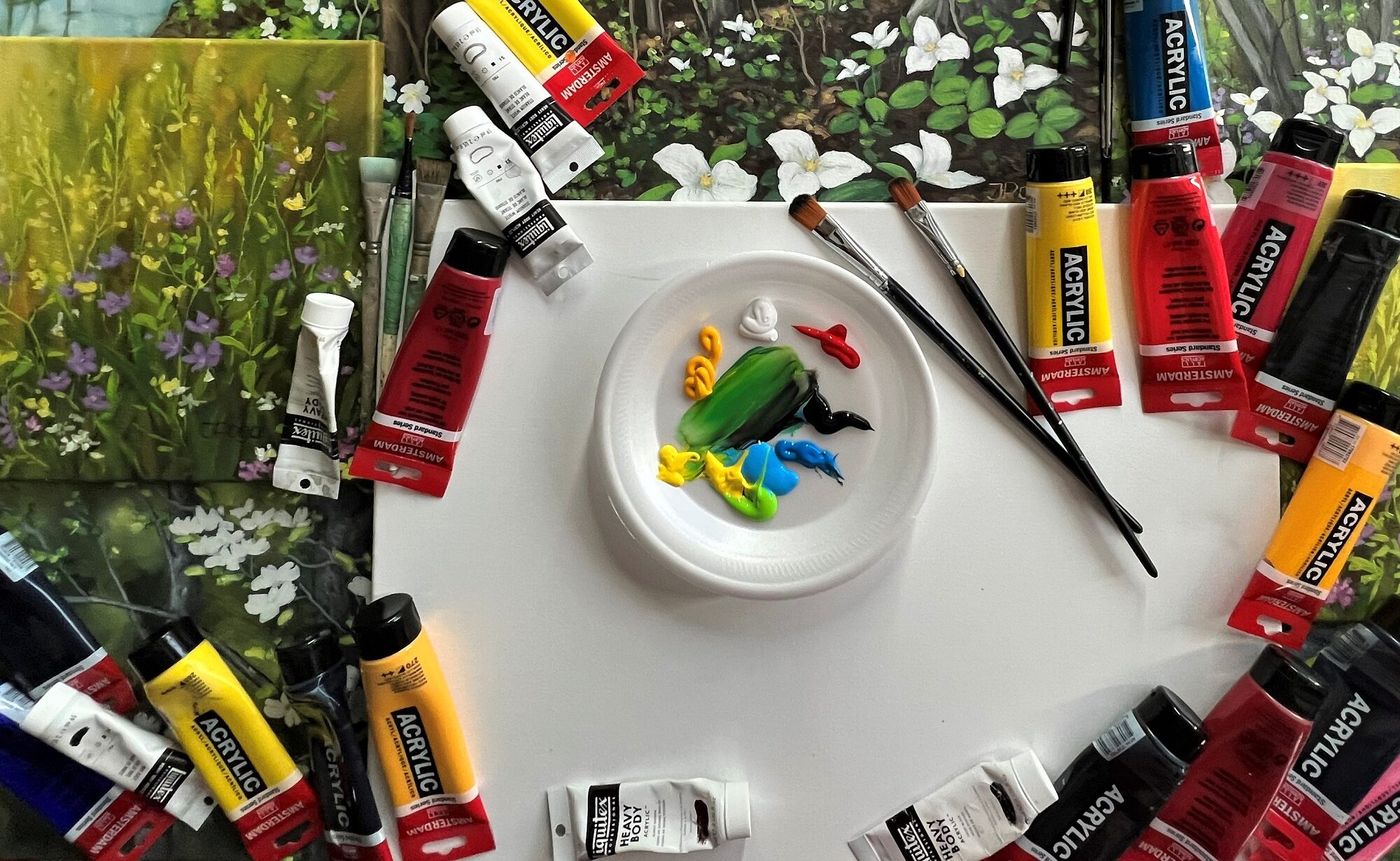
I have elaborated a new approach to acrylic flower painting since many students want to learn painting with acrylic, but their results are quite often disappointing and don’t make them happy. We use the large-scale drawing, transfer it onto canvas and then follow with paint. This new approach uses the specific features of acrylic paints: short drying time, ability to work over dry layers; and turns them into the biggest advantage. Results are quite stunning. However: results are great as long as one follows all steps and uses multiple layers of paint.
Everything matters
So far, I have given only live art classes because they make a lot of sense. Explanation and even watching somebody else painting do not always lead to good results. It matters how much water or how much paint, or what medium on what surface one uses. It matters how fast the previous steps are done and it matters how you move the brush and mix the paint. Everything matters, and we can correct mistakes right there as they happen. It is great that somebody can explain why some things work and why some others don’t by doing it in the classroom.