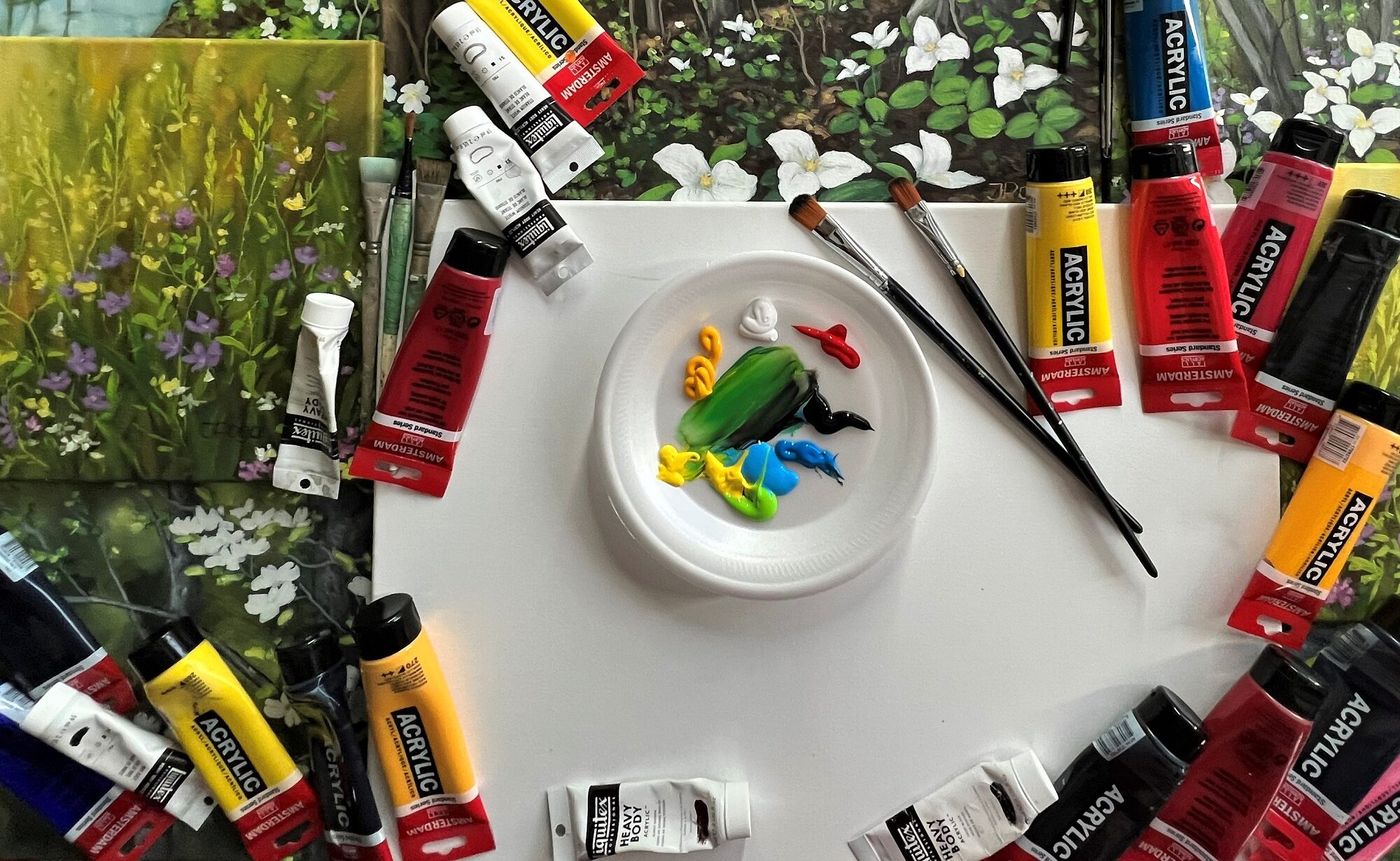
What to paint in the summertime? If you are in the countryside, traveling or live in the suburbs, I believe it’s impossible to avoid painting at least a few landscapes. What do we include in the summer landscape? Everything which speaks to us or says loudly: it’s hot, it’s wonderful, and it’s summer. My summer landscape is based on my surroundings and what I see outdoors. My private park has numerous wildflowers, and it is actually rather wild with huge old trees, various greases and plants.
We can interpret any landscape in numerous ways. Choosing certain color for wildflowers, buildings, sunny or cool color for grasses, adding trees or water, roads or fences – it depends only on artist where you want your viewer to go. I would like my viewer and art collector to feel happy about what nature provides us with, enjoy the views which might not be around forever. In that regard, I am documenting the natural beauty before we kill the Earth completely. Thee is so much beauty in the simplest summer landscape.
In my opinion, taking pictures of art and then posting them as separate images without background, literary destroys the art. I do that still because many places require to do so. Original art breathes and emits plenty of great, uplifting energy. All devices and cameras take away a lot already, and the small image you can see on the phone isn’t really my painting. It’s gone through numerous adjustments and algorithms. Regardless of that, I hope the energy within my summer landscape paintings is still visible.
These particular paintings were created between 2010 and 2021. There are many more, but one post can include only few images. I believe I already added too many pictures, but – when else to allow color to sparkle and imagination to run freely? I intend to initiate Studio 65 sale to celebrate my birthday. That’s pretty much the only celebration I will have. Most of paintings are available as originals and also as prints. Originals are available from my art studio in Ajax, Ontario, Canada. Prints – anywhere.
Bright and happy, we could use more of that, couldn’t we?
Wish me well? Maybe buy a small art print or all kinds of things with my art, including puzzles, from my Fine Art America site:
If you have been painting for a decade or longer as I am, it’s possible to see how all artworks fit into art collections. What are the criteria for creating art collections? There are many, and any large body of artworks can be sorted out by medium, style, certain color or particular subject. The best example is my Fine Art America art collections. I have put together art by medium, by subject, like floral art, still life, landscape and also by color. There will be black and white art collection available soon, as well. See link below or on Menu.
Painting from imagination
The spring as always is arriving slowly in Ontario. We see long periods of grey and earthy colors around us. The more grasses and trees wake up, the more patches of bright green are visible. Therefore, my grey and abstract watercolors were a good match for my surroundings. As I have mentioned many times, I prefer not to use any photos for my art. The spontaneous watercolors are simply watercolor washes at first, and I sort them out as I go and add definition. It is extremely easy to create art collections of abstracted art.
Getting composition right
Classic painting consists of background, middle ground and foreground. Plus, we need something to capture viewer’s attention with. It’s called a focal point in art. Everything including lines and colors of different values is organized in accordance with our composition. I believe that composition is difficult to implement when the artist doesn’t feel visual balance and natural flow of their image. I personally do not use any view finders or similar tools; I just adjust my composition as I feel it. Some of my art collections include highlights of compositional elements.
Simplicity versus complexity
Fragmented art can look better sometimes than very accomplished and compositionally perfect painting. Art collections can include simplicity or complexity of a particular subject, use of color and compositional elements. The blue period art collection displays exactly that – simplicity and strategically placed watercolor washes.
Art reflecting the season
Most of my art also goes by season, therefore, I have seasonal art collections, as well. Spring and summer landscapes, fall colors and snow paintings, they are all interesting on their own and placed in art collection. Floral art is a very big part of everything I have ever painted, I think it deserves a separate post. I know people who have painted a few artworks, some five or six paintings, and they try to immediately sell them and even teach painting. Well, it’s better to allow our skills to mature so that we are represented by what we do well, not by our first attempts at painting.
Buy original painting?
Original paintings have never been more affordable than they are now. I looked at my price charts from 2013, and my paintings sold for double the price I have listed now. That’s a horrible thing because everything has become at least 5 times more expensive. That includes watercolor paper, paints and I won’t even mention framing. There are inexpensive options, but I simply have too many paintings to frame each one. Therefore, I’m offering some framed art and some – unframed.
Available watercolor painting originals are posted on this page:
I am impatiently waiting for spring, and while it is still cold, windy and cold with snow covering most of the soil outdoors, I paint spring. I paint spring using my spring color palette which is pretty much always the same. My spring color palette includes different grey tones, as well, but camera cannot keep up with my soft color transitions and frequently sees grey as blue. I hope, the spring color palette can be perceived as you look at my paintings on your device. As we well know, any device has its own settings, thus, impacting heavily what one sees.
Color palette also changes
I have had many favorite color stretches over many decades while painting. I have had totally grey phases, and very blue, very green and bright multicolor painting periods also. As an artist, I never stay the same because everything changes and our hate-love relationship with colors changes, as well. I love balanced color palette and use it whenever possible. Phone camera wasn’t designed to get things look real, but rather enhance everything. It also destroys correct perspective regardless of how you adjust it.
Imagination at work
Spring color palette is vivid and rebirth-affirming. I’m very sure if you live in different climates, your color palette is quite distinctive from mine. I don’t paint mountains or oceans, just because I don’t see them here. I also don’t rely on photos, but rather on imagination and visual memory. That makes things easier for me. Simplicity which excites is a good term to describe these paintings.
Saturated colors
The old house was painted in 2018. Apparently, watercolor works much better on thick Arches watercolor paper. Layering colors is easier and the entire painting has more saturated values. Pictures which I took with iPhone back then, are rather dark and some look even blurry. I should get new pictures of all paintings which I still have, but that’s too much of work and too much of re-posting and editing. I did, however, take new pictures of the old rural house.
Old house watercolor painting in spring colors, 20 x 16 in or 51 x 41 cm
Still grey and Road into distance paintings
Still grey with birch tree and the Road into distance are new watercolor paintings. They are created using the same color palette, but I couldn’t get a good image of the large one, the Road into distance painting, It’s a fantastic, large size watercolor with beautiful color transitions. I would say, it has gentle and soft spring colors and all values are simply perfect. If you ever happen to be in Ajax, Ontario, you could stop by and see with your own eyes how no picture can ever match the original painting.
Road into distance, 24 x 18 in or 61 x 46 cm watercolor painting
If you just started painting with watercolor
If you just started using watercolor, always test your colors. Nowadays, the color name alone doesn’t mean much. I have 3 Payne’s grey paints from different manufacturers, and they range from rather blue to very black color. The same goes for Sap green and Green gold. Burnt sienna and Raw sienna are very different colors from different manufacturers. All blue colors can be anything. Yellow is usually quite weak color from the student grade sets.
Still gre, spring landscape painting with birch, watercolor
What you can do on your watercolor paper
You should also test watercolor paper. It’s not advisable using anything lighter than 140 lb for watercolor painting. Non-cotton paper generally buckles, warps and doesn’t absorb neither water, nor pigment. Therefore, you cannot expect watercolor wash to be perfect, adjust it with paper towel. If there’s too much water on such paper, it settles down at the lowest point due to gravity and you see the “blooms” which look good in abstract art, but wrong in improper area. It’s very easy to lift paint from non-cotton paper. It’s easier for beginners because you can correct many aspects of your painting.
Don’t expect the same outcome
Cotton paper, like Arches allows achieving fantastic washes. It absorbs paint and pigment, therefore, one needs to plan painting. You can stretch and soak it before painting or use water on it before you start painting. I didn’t use Arches this time, but Strathmore 400 series paper. Getting paint on it is more difficult than lifting it. The number of layers is limited. If you use Arches (at least 140 lb. paper), number of layers is quite unlimited. Arches 300 lb. paper doesn’t buckle at all. It’s like wood, thick, firm and allows using and creating great effects. It’s very expensive at the moment, though.
Thanks, talk to you later in spring again! This post is different, thanks for reading!
What to do during the dull and dark February days? Probably, just keep painting. Acrylic painting is a bit more difficult with heating on, but it is also very rewarding. I pick myself up and place in the middle of spring. We used to go for walks along the Highland creek which offers attractive views and many varieties of trees, wild plants, chance to watch animals, jump over rocks and rushing water. Creek is wide in the middle part and water stays quite still in some spots. This is like mental transition in time and to another place. Thus, spring landscape is born.
Central part of Highland creek flood water painting
Imaginated reality
As you know, art has no restrictions. That includes the painting subject, colors we use, parts we paint and parts we don’t. I’m usually not that worried about how realistic something looks when painted. There must be some joy and fun put into every brushstroke. I usually paint as I see something in my head. When I look at empty canvas, I can easily visualize what is going to be there, in this spring landscape for instance. Similar to when we have a piece of fabric and we can imagine how the ready outfit will look. Imagination has no borders, too.
Top part of Highland creek flood water painting
Spring landscape as painting subject
This Highland creek flood water painting was done for the private art classes. I thought spring landscape was very fitting since we can paint much less of it or add much more to any part. We can leave the distant part completely abstract. Well, my student was impatient and here and there jumped over the gradual steps which processing an acrylic painting requires. My demo steps got jumpy, too, but, nevertheless, this painting was brought to completion just a few days ago. What you are seeing, however, is not the painting, but images of it. I straggled getting all parts of it onto pictures.
See painting steps above
Getting correct colors in acrylic painting
What’s most important for me personally, is whether the mood in an artwork can move us, inspire us, make us want to be there, in that place which doesn’t actually exist in the real world. I am trying to also teach my students patience and correct use of acrylic paints. While any wet acrylic painting might look perfectly right, it will definitely dry darker. The weaker the paint we use, the darker our painting might become. I regret noticing how Liquitex heavy body professional grade paints have lost some of their quality over years. That refers to Titanium white and yellow shades.
Close-up of front part
The usual acrylic painting principles
Regardless of our artistic intention, we always work from dark to light in acrylic, always from underneath upwards, always from back to front. With heating on, acrylic paint can dry immediately, therefore, we glaze separate parts and work in small segments. The lore layers acrylic painting has, the better it will look. That especially refers to the moment when somebody sees the actual painting in person. I sometimes go over even the final layers if the paint has become too dull in some spots.
Highland creek flood water, acrylic painting 24 x 18″ or 61 x 46 cm
Place yourself in this spring landscape
I hope you love this spring landscape and its mood. I believe you’d hear birds singing and water rushing over wet rocks and grasses if you are able to forget the surroundings for a moment and be immersed in this painting. It’s in great size, not too huge, not too tiny, 24 x 18″ or 61 x 46 cm. The steep vertical format adds a good quality to this spring landscape and pushes compositionally important elements close to the viewer.
Just like always, thanks if you read my post! I intend to catch up with likes and comments.
Watercolor has been one of my most favorite painting medium options for more than 5 decades. I still have a few of my first paintings somewhere, deep in my numerous art folders. I was about 10 years old, I was drawing very well, just like I do now, but my watercolors were not sparkling. I come from a family which didn’t have any relationship with art. In the neighboring house, an artist was renting a room. Her watercolor paintings were way larger and way brighter. They had more volume and more contrast. I asked her to see her paints. She showed me the most fantastic box of watercolor paints. Back then, they were Leningrad watercolor paints which later transitioned to St. Petersburg, and then White night paints. The difference was astounding. Clarity and saturation of pigment charmed me on the spot.
Why to invest in good art supplies
Ever since I tried St. Petersburg watercolor paints, I always tried to find them and use. When I relocated to Canada 18 years ago, I had only a tiny paint box with me, but I quickly realized I will need more paints. So, I shopped the brands available in North America. Expensive they were, the artist grade paints, but they didn’t come even close to my favorite brand. Now with all the Russian issues, I’m in trouble again, but I hope to get some replacement paints. The most understated feature when learning to paint with watercolor is the quality. That refers to quality of paints and quality of watercolor paper. With bad paints and using them on a bad paper, all we can get is unsatisfactory color and contrast, plus bad paper simply cannot take layers and corrections and it buckles and warps. It is limiting.
Captures of fall using watercolor washes and fine detail
Importance of good watercolor paper
Good watercolor paper is very expensive in Canada. The 300 lb cotton cold pressed paper comes to almost $30 or more (with taxes) per 1 sheet. Sheet is approximately 29 to 30 inches x 22 to 23 inches depending on brand. The use of bad paper and weak paints might be the main reason many potential watercolor users give up. Well, I am using sometimes non-cotton papers, too, but no other paper compares to the real thing when you need to apply a wash, gradual wash and fine detail. I prefer using the large size and full-sheet paper since there’s no way to paint something meaningful on tiny size paper.
Autumn leaves and sunflower, both are 20 x 16 in or 51 x 41 cm
Fall colors for beginner artists
Fall season is a great time to consider painting in colors because it is very simple to apply warm and cold opposites and create something great. It is easy to use more abstracted style or add definite detail when necessary. Inspiration is everywhere assuming you get a chance to be in an area which has trees and other landscape elements. Even a few leaves can create a good composition and then you can just add fence, brick wall or washes for background. It is definitely more rewarding to use real things as models for painting. Not everybody knows how to use photo, and your style will emerge sooner when you are not affected by pre-set colors and composition. You have more freedom.
Relaxing experience with watercolor paints
I usually do not participate in challenges because days are filled with numerous tasks as it is. I cannot be sure I will have enough time to paint something of decent quality every day. For me, it makes sense working when the time is right and I don’t feel rushed. People who have similar conditions to mine, frequently experience depression. It comes and goes, and can be of different severity grades. I noticed, however, a few days ago when I finished up the Fall tree on lake shore, I felt simply excellent. For me personally, painting with watercolor is an extremely relaxing and calming experience. Creating the bright color transitions makes me feeling way better than usually. I could say, using bright colors cures and soothes upset mood.
Birch path is large, 30 x 22.5 in or 76 x 57 cm
Dark colors without actual black in watercolor
I never use black color in watercolor painting, and I do not like dark watercolor paintings also. The reason is simple: black color indicates areas absent of light. If you are in a totally dark and black space no light waves are coming through. Generally speaking, I don’t like dark spaces, dark clothes and dark living environment. From the practical painting perspective, black color can make other colors muddy in watercolor painting. For extra strong values, we can use raw umber (very dark tone of brown), Payne’s grey (almost black blue), sepia (practically black with brown undertone) and mixes of dark blue, dark violet with other colors of your palette. The safest combinations in my experience are with Payne’s grey.
Art classes for adults in Ajax, Ontario
While there are many art classes, it’s so that lots of them are the paint-night type where there is no actual learning. Good painting takes time and skill. You might want to paint more abstract art, but you still need to know how your paint pigments interact and what your brush, sponge, other tools and materials, as well as paints can do on that particular paper you’re using. Every type of paper acts differently. With globalization, art classes have become part of online domain. However, I’ve never met a student who was able to paint whatever they had intended after watching online instruction videos. In reality, you need to obtain some habits which facilitate painting. My art classes are different. And I provide students with skills which root in my many-decades-long experience.
Lake tree watercolor is 24 x 18 in or 61 x 45 cm
Adult artists in and around Ajax, Ontario! You might find your passion this fall season engaging in creation of colorful watercolor art. Calming, soothing and very uplifting! Especially when the days get shorter. Thanks and have a good fall season!
NOTE: I noticed my watercolor painting images from this post on some strange websites. Well, that’s infringement of my copyright. If you see my paintings somewhere else, but not on this website, my Facebook profile or Fine Art America, they have been illegally stolen.