Just like birds, I will take off tomorrow. I won’t go south; however, I will go east, to Latvia. Whether we like it or not, September is soon over, and October will come with its gold to soothe and comfort our aching souls because, oh well, we are heading towards the winter. Eventually, snow silver will cover the rusty golden sparkles, and our feet will be walking the icy and cold sidewalks of freezing town and city roads. I love the colors of autumn, just like we all do! It is such an injustice that this beauty disappears so fast. Nevertheless, it is a great time to capture and enjoy the fantastic colors. Regardless of personal preferences, nature’s cycles are inevitable.
Fall art projects
I kept working on some projects and I also tried to bring to finish the class project: the distant blue background and the lonely tree. Pumpkins are going to be uploaded to Fine Art America; maybe somebody will like them as greeting cards or other products: there are so many now that I cannot even list them all.
Looking forward to my time in Latvia
I will try to report about my adventures in Latvia since I have a new laptop. Laptop is fine, I would not say I’m very excited about Windows 10, it came with so much abusive stuff which I never intend to use that it takes me hours and hours to adjust my settings for my personal needs.
Alone: lonely tree; 20 x 24 in acrylic painting, it was sold to Brenda. Thanks, Brenda!
Pumpkin and apples for Thanksgiving, 20 x 24, in acrylic painting
High above, acrylic painting, 20 x 24 in by Inese Poga, sold
House under the big sky, it’s a very large acrylic painting, 30 x 40″
Painting tip for students
If you would like to paint some fall scenery, put the color you want to use exactly on a spot where you want it. Do not keep brushing the paint around for so long that everything becomes the same color. This is easy using a feather-like, light brushstroke. It is like running on a spot: you just use the flat and wide side of the brush with light motion, so that it mostly is parallel to canvas surface.
Enjoy the sunny fall days and survive patiently the dullness of rains and chills of winds!
Everybody can draw. And everybody should draw; if not at artistic level, so, for pure pleasure and healthy brain. I hope you are not one of those parents who make remarks like this: stop playing around with pencils, do your math assignment! While we all need literacy skills and math, there is something unique about drawing. We can draw before we can even speak or write, or count.
Path to artistic freedom
We can actually do it successfully without any regard to any rules which people have imposed on creative expressions and art. We can very well express ourselves until somebody says: that doesn’t look like a cat! That’s when the kid who loved to draw starts to wonder: really? Am I doing something wrong? That’s where the artistic freedom ends and rules start. Art is categorized as not that important compared to coding, IT, math, chemistry, physics, history and essay writing.
Drawing and painting for brain fitness
We have so much evidence nowadays that drawing and painting actually has the power to activate our brain to a huge extent and keep it flexible. Focus, memory, attention to detail, decision-making, imagination: these features are so important for anything we do in our life, and they are developed and perfected while we are just drawing and painting. In addition, this activity means a lot of pleasure, it is also rewarding.
Requirements for brain flexibility boosting tasks
In order a task or activity would boost brain flexibility and our memory, it should be:
challenging task;
new task every time;
task that involves decision-making, observation, focus and attention;
task that prompts to come up with solution;
pleasurable task and activity;
rewarding task and activity;
activity or task which enables socializing and exchange of opinions.
If you can write, you can draw
People, who think they cannot draw, have been simply using a wrong approach or have convinced themselves that drawing is something they’d never manage. They might believe drawing is something they don’t like or would never need. They might be addicted to devices and screens and they might see no point in using their brain and hand. However, fine motor movements are extremely important. Everybody, who is able to manually write, can also draw.
Manual drawing is not that common
I am obviously checking out what other instructors and classes offer, and I must say there’s not that much. First of all, if instruction starts with: take a picture, that is not going to be a lesson how to learn drawing. That instruction will tell you how to reproduce photography and sometimes advice to just trace the image and take credits for a great drawing. Why do we always need to focus on the final product? The process of creation is very exciting, and this process is well worth experiencing.
Seeing is the key to drawing
Drawing is not about copying or measuring. Drawing is about seeing, activating the brain-hand communication and creating an image of an object, person or view on a flat surface, at the same time trying to show the emotional impact we are experiencing. Before we can draw, we have to learn seeing. Most people are convinced they see everything, in fact, they see just a non-specific image, and they don’t pay attention to any details.
Practical advice for these who start drawing
When I’m watching people drawing, I have noticed the following: they rarely look at the object they are drawing or painting, hardly ever. Some follow my drawing, some look at the paper all the time and erase everything and start from new quite a few times and erase again.
Practical drawing
In fact, we have to focus on the subject we are drawing and just rarely take a look at how lines and shapes are forming on our paper. We have to draw the subject 2, 3, 4 times bigger than in reality. Also, memorize the subject for 3-5 seconds; explore the shape and values, look at paper for 1 second. That happens on its own after a while.
Forget eraser
I would like to take away the eraser, too. Eraser just disturbs during the initial drawing stages. Therefore, try not to erase everything. Focus on outlines and shapes, as well as size, scale and proportions with the first attempt. Start with light approximate lines, define them as you go.
The starting point and reference area
We have to visually perceive the subject or scene, find the reference area or spot and start out with very light general lines. With every next line, we are building up the subject or anything within the drawing. We should also stick to what there is and what we can see not converting it into an animated, simplified shape of what we know this object might be like. We should not omit and take away all specific features our subject has in reality.
The purpose of these outline drawings is to serve as a base for watercolor painting because some plants, vegetables or flowers don’t last long enough
Leaving only good lines and going over with black pen
Good subject for starting out
All apples are not the same; all cups are not the same, not to mention trees and flowers or faces. Still life is a very good starting point, and I’d usually pile up more simple things in order we could observe their relationships. Therefore, learn seeing, develop visual perception and visual memory.
We add now watercolor to lines and get a nice painting!
The positive impacts of drawing occur especially when we are employing the entire brain which is as in observational drawing. It also makes us completely independent from computers, cameras, phones, printers and other devices because all we need to start out is paper and pencil or pen. Good luck!
I have been mentioning in my articles for numerous times how huge the gain from learning drawing, sketching and painting is. Drawing and painting is not intended only for those who want to be artists or already are involved in creative activities. Drawing is an activity everybody can pursue and art class helps.
Repair and boost cognitive function
There is more and more proof that learning and doing arts is a unique activity which boosts brain activity and development of new neurons and their connections that there is no doubt: drawing, sketching and painting is the best exercise to keep our brain fit, thus, preventing early memory loss and age-related dementia.
Enjoy and have better memory
I recently read about a new brain fitness trial which was carried out at the Newcastle University in a population of 30 volunteers divided in 3 groups for 8 weeks. One group was walking for 3 hours a week, the second doing puzzles and crosswords, and the third group took part in art class 3 hours a week. All participants were tested before and after their respective activities.
The best results undoubtedly showed the art group, which is no surprise to me because I’ve observed that during all years of teaching. I would like to just mention that I have been working with student groups of 5-30 people for almost 35 years, and those who did arts quite often excelled in ANY area of their life.
If you can write, you can learn drawing
Is everybody able to draw? Yes, everybody is able to draw, but in order to do so they have to learn seeing and processing the object of interest in their brain so that the hand knows what it should be doing. Along with maintenance of good brain health and memory, it is a fantastic, rewarding leisure activity. Once one knows how to draw, they can forget about camera, image processing on computer, they can forget about copying photos.
Mastery is time- and effort consuming
Well, those, who want to master drawing from life, must count on 10,000 hours, at least. That’s the estimated time frame to learn drawing effortlessly. Although, the benefits are so obvious, majority of people will admit they cannot draw. In fact, the truth is they don’t know how to look at something, how to pay attention and what to look for The ability to draw is based on our visual ability to process the visual information and to make our brain move the hand with pencil.
Before you draw, you must learn seeing
Therefore, before we draw, we have to learn how to pay attention and notice relationships between parts of an object, its layout, size and how to reproduce everything on a correct scale. That means, most people see things, but they never focus enough to memorize what they see. At least it is not enough for being able to draw from memory.
First attempts
What are the usual problems when starting out with drawing, sketching and painting? It depends on whether one is at the class only for the result, or for the process. Process is good for everybody, but results are evident after longer time. I have sometimes people, who want to achieve excellent results right away, in 1 workshop or 1 class, or they think, it’s not worth continuing. While we progress, we can still enjoy a lot and give our brain the necessary exercise.
How to get better with drawing and painting
Watch, learn seeing and exercise focusing ability! Drawing is not the same what copying photos, transferring images from photos or printing off outlines. Once one gets used to flat objects in a photo, they will have much harder times to ever learn drawing from reality. Reproducing photos also does not facilitate the brain activity as drawing for real does.
The initial steps don’t look that great, but after adding some 8-10 payers, we get extremely good results
Learning changes our ability to see
All people, who wanted to participate in drawing and sketching classes noticed soon that they are seeing everything in a different way. Would you like to boost your memory and have some pleasurable pastime? Join the club. We are starting out next week. I’m sharing some pictures which show different types of drawing. We usually draw with very light lines for watercolor painting. We can sketch out main values if the reference object can go bad or disappear soon.
I actually completed one still life only 3 years later and the large still life 4 years later, but since I had a sketch, it was no problem. Here is link to the large still life and how it came out: Finished large Autumn harvest still life
In my opinion, the only way to draw efficiently is using real subjects, real setups or ask somebody to be a model. Everything else means reproducing photos. Some do this very creatively and successfully, some not that much, but only manual drawing from real subject makes one free and independent of any devices. We can interpret our painting also in any way we prefer while photo limits one to use only what is on a photo.
Positive energy is a big part of my art. We all probably used to have sense of energy and its vibrations, just like animals and birds still do. There are energy-sensitive people, people who do not feel or recognize any energy flow, but experience it subconsciously, and people, who are unable to perceive any energy at all, even though, they are just like everybody else affected by it.
With good thoughts
I paint implementing lots of positive energy in my creations, it’s not only because I cannot make myself draw or paint gruesome, terrifying or evil subjects and scenes, but mainly because that is who I am: a medium for converting the great energy from the impressive nature scenes, flowers, still life subjects into the sensitively perceivable feeling of good vibrations. I doubt this could be felt through the internet images or prints since these are copies of copies. I know that people, who look physically at my paintings in person can experience such strong, good impact.
Red as energy carrier
I have painted numerous red flowers as commissions – poppies, wild roses and similar floral paintings on request of people, who can sense energy and are able to recognize it. Some of them have placed my paintings in the entrance hall to prevent bad luck and bad energy from entering their personal living space. I know a couple, who hang a flower painting of mine at the upper staircase overlooking the entire stair, and they told everything became much better and better in their life since that.
Take it from subject
Some people wanted red flowers for their living rooms and some for bedrooms as an energy carrier for passion and love. I believe any appropriate place is good, and these paintings work well because I have puts lots of positive energy into them. I take it from the beauty of objects to be painted, and these paintings become a shield to stop the flow of disturbing energy.
Let energy flow
When it comes to positive energy, its flow in a room or in any space matters a lot. Color matters and the subject is important also. Therefore, I’d advise to use for personal space only such paintings, art and items that enable the flow of positive energy, not block it.
There’s nothing which makes a room look more cozy than good art. If you want to take the easy path, certainly you can go with color splash and abstract art or no color at all. However, since I always have many paintings in just one room, I can tell that the colors do not disturb and art which displays recognizable subject looks fantastic. It might take more time to decide what exactly to hang on your walls, but there’s no limitation of choices.
Art which releases positive energy and good vibes is usually sold. My art sells the best when people can experience its impact in person. Many of paintings which you see in this post are sold. It makes me happy that somebody else find my art so appealing that they wish to have it in their homes.
Finally, a very large painting from 2014: the Nostalgia gardens. It was sold also. There are definitely more and new paintings to enjoy, to purchase and have the positive energy always with you.
I hope you enjoyed! I would appreciate a lot if you stopped by at the art studio in downtown Whitby, Ontario to have a look at original paintings and at FFA online site to check out all art products.
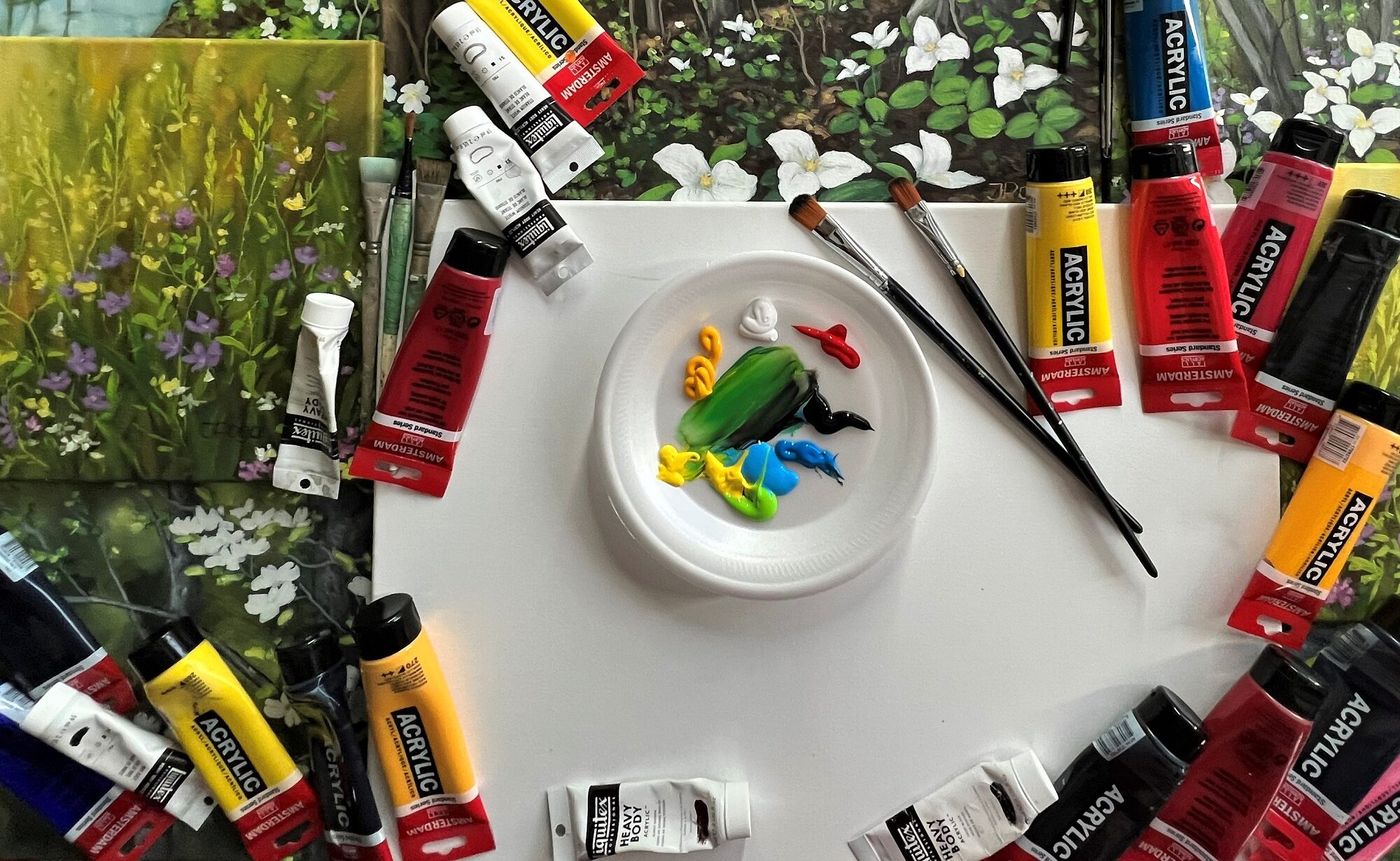
Some painting tips, especially for beginners in acrylic painting can be always useful! Many people have time and opportunity to do something about their creative intentions during the summer vacation. I will also answer some frequently asked questions. I have attached the demo art from a few recent art classes and workshops.
The favorite brush
Always use the brush which feels comfortable for the part of painting you are working on. It is difficult to draw fine lines with a huge brush and vice versa: it takes too long to cover large are with a tiny brush. Over time, every artist develops some kind of attraction to a certain brush whether flat, fan brush or round. It is very possible to paint the entire medium size acrylic painting with one medium size flat brush from start to finish.
No pressure
We should never try to put pressure on ourselves or canvas if some painting step doesn’t happen. As with all water-based mediums, timing is an important part of acrylic painting. We should always use large loose brushstrokes for the first layers and keep the textured impasto approach for the most important areas and for the end. exception is when you are using the texture medium or modelling paste at first, then the sequence will be slightly different.
Cleaning brush
Whenever we move from one color to another, we have to rinse the brush and swipe it on a paper towel. It is important not to have too much water on a brush before you get the paint. You need just a small bit of water. Acrylic paint darkens as it dries, therefore, the values might appear not as they are while the paint is wet.
Keeping acrylic paint workable
Extenders and flow medium can extend the working time, however, working with sticky paint may be not suitable for all areas. It is better to work on segments and use mix of medium and tiny bit of water for re-wetting large areas. Too much water can damage acrylic paint. Brushes must always stay submerged in water while we paint. We can rinse them under running warm water and wash with soap afterwards.
Create monochromatic base image
If the object or scene is very complex, it is great to paint the main parts just in one color: create a monochromatic base image. Changing and adding color is very easy, the most difficult part is achieving the right values, color intensity, proportion between light and dark colors.
Early spring was done entirely during art classes and served as a demo painting
Expectations and real painting
It can happen that participants have very high expectations when they come to the 3-hour painting workshop. In general, one has to be a realist to some extent. If the participant has never painted before or has done a little bit of painting 20 or more years ago, the first painting will be an interesting exercise. That helps understanding what it means to paint with a brush and to try mixing colors. I would not advise to expect it to be a perfection and best art ever created. Who gets better when just starting to paint? People, who are able to take risks, to experiment and who dare stepping out of their comfort zone.
Acrylic landscape with purple and yellow flowers, sold
You will have to learn and paint it
Signing up for a painting class does not mean that painting will paint itself. The art instructor is not a magician, but somebody who can explain, show, demonstrate and correct if something goes completely wrong. Live classes are much better than any online classes because I can see right away what is causing a problem: too much paint, too less paint, too dry or wet brush and so on. We are painting not only with brushstroke, palette knives and sponges, but also with hand pressure, heavy or light movement of the hand, arm or wrist. Application of paint is a big deal and that is something which is best done in the presence of an instructor. I usually explain why the particular image or composition is good or isn’t, why the particular choice of color works or doesn’t.
Road to spring was created during art class as a demo for group.
Some tips for beginning artists:
Whenever you have time and chance, pre-paint your canvas in light cardboard color using burnt sienna, yellow ocher and white. Instead of white, we can use gesso, as well. Acrylic gesso is acrylic primer, it seals the pores on canvas or any other material, that includes wood panels, plastic and similar materials. It allows using less paint and it is easier to apply it on previously primed surface.
Behind the ben: acrylic painting of spring road is 20 x 16 in or 51 x 41 cm art on canvas
Think layers
Think in layers, separate in your imagination the part which is behind and underneath, in order to avoid working on small details right away. I’m often seeing how everybody tends to move to fine details way too fast and well before the entire scene is blocked in. We always start from the back and with the background. Unless there is a large very light part, we have to start with dark and medium dark colors. That seems to be the most difficult part for beginners. We do not use the final color at the beginning, but we build it up layer upon layer.
We were painting Birches and bluebells during the last adult acrylic painting classes, my painting is sold
Applying color or building it up
There is a big difference between applying color and building it up. The further we are in the painting the closer we move to the front part. That is a bit different with separate objects like in still life or floral painting. However, we always start with more general things and just afterwards move to particular parts and details. In oil or acrylic, we always go from dark to light and finish up with small areas of highlights. If we have lost the dark parts, we have to paint them back in.
Start over
If you think that some painting is not good enough and it is not worth trying to make it right, you can cover the entire canvas (previous painting) with a mix of gesso and some colors and start a new painting. The small imprints from old painting lines will add more texture, they most often look interesting, and you can build up a thicker layer above the basic layers.
Correct everything
It takes a lot of effort to damage an acrylic painting completely since you can paint it over for as many times as you wish and have time for (or patience). Being afraid to do something wrong in acrylic painting has no reason – you can correct practically anything. It will take more work, time and paint, that’s all.
Happy summer painting! I hope you enjoy the summer painting tips!