Why to engage in value drawing and value sketching

Black and white art, value drawing

How value drawing can help

Why should you spend time on value drawing? If you do such drawings large or full painting size, it will take quite a lot of time, from a few hours to a few days. However, these value drawings will be all reference materials you need. I have added many photos of my very large still life drawings, so that you see what I’m talking about.

Drawing for watercolor

I started to do such large size value drawings because my goal was to eventually create a watercolor painting. As you may know, watercolor paper is very fragile and painting does not look good if there are lots of visible pencil marks or even worse. Erasing damages watercolor paper. I do such drawings on tracing paper. That is because I use a specific drawing transfer technique which allows seeing my final drawing very well without applying graphite pencil too much. It saves me work afterwards and prevents my paper from damage.

Large is great

I make these drawings large, to be more exact, the actual painting size. I usually paint full-sheet 22 x 29 inch ( 56 x 74 cm) watercolors, and sometimes a bit smaller acrylics. The drawings shown in my photos are 22 x 29 inches ( 56 x 74 cm) and 20 x 24 inches (46 x 61 cm) .

I usually do these and similar drawings in class, 20 x 24 inches (46 x 61 cm)

Value drawing is a guide and a map

All answers to questions which arise during the painting process are in the value drawing. I love painting from real things as opposed to photos, and if the subject is sensitive, such as flowers, food, fruits, vegetables or moody nature scene, I have to use something which quickly captures the subject. I obviously cannot get done a large painting within a few hours. Therefore, instead of taking photos, I do value drawings and sometimes value sketches.

Camera doesn’t replace visual perception

Partially, I don’t rely on photos since I got my first camera not that long ago and I was very much used to draw everything what other people were taking pictures of. The other aspect to that is the way any camera distorts the subject or view. My eyes perceive it much better than any camera would, and I create a composition on a fly.

Photographic visual memory

I don’t know whether I was born with it or whether I just developed it, but I only found out quite late in my life that I have literary photographic visual memory. I simply did not pay attention to that when I was young.

Advantages of having great visual memory

School was easy for me. I memorized everything extra easy, and I added an analytic approach to memorizing things. I am still able to remember lots of text just by looking at it. That helped me enormously when studying at university. I personally think that my visual memory comes from drawing. I was drawing everything whatever I saw since age I cannot even recall. Parents told me about that. It was a surprise because there were and are no other artists in my family which is actually quite extensive.

Memory can be improved at any age

I do believe and have seen that visual memory can be improved to a great extent. What happens in real life is that people most often don’t use their memory and brain. The more support from devices we have, the less we use our own memory. That is disastrous and leads to early memory loss.

How drawing helps keeping excellent memory

It is obvious that one can have all kinds of reminders and lists on their phone and computer. However, there are people like me who never ever compile a list or use a reminder. I’ve never forgotten any appointment or meeting in my entire life. I never make any lists, neither shopping, nor to-do lists, not even invoicing or student lists. It is all comfortably filed in my head.

My most recent drawing, 20 x 24 inches (46 x 61 cm), it can be used for any painting without any photo reference

The reason I love drawing

I don’t draw to only exercise my memory. I draw and paint also not because of likes or social media comments, followers or any other feedback from fans. I draw and paint because that is my way of life. I live in a visual world where everything is a painting and any view is art. That is the way I see the world and life.

Multiple and various uses of value sketch and value drawing

Having a value sketch or value drawing is of big advantage, not only because you have a perfect reference and guide, but also because you can use this value drawing with any painting media afterwards. You can go ahead and complete it as drawing, pastel painting, transfer to watercolor paper and paint with watercolor, transfer to canvas and paint with acrylics or oils. You can reuse it and flip it, as well. Finally, you can use any part or fragment of value drawing, as well as create a composition which consists of value drawing elements

Any of these drawings might become paintings, this one is  22 x 29 inches ( 56 x 74 cm)

It is a preview

It also serves as a sneak peek. It is clearly visible what works well in your composition and what not that much. Therefore, it is possible to correct everything while you transfer the drawing, so, that you do not have to deal with issues during the painting process.

Test your values

Test your values turning the image of painting into black and white. If it still looks good, your values are correct, and so is the contrast.

Uniqueness of our drawing style

Drawing is like handwriting, and our personal style is like our handwriting. It carries the specific features of our character, nature and mental abilities. It is possible to describe one’s nature by simply looking at their drawing. It is and it should be unique. Don’t trace photos, it is so much more rewarding to simply look around and see.

Still life is beautiful and teaches all drawing aspects

You don’t draw because you haven’t tried to do it right

When somebody says: I cannot draw, that actually means they are not interested in seeing the surroundings or the subject. How much one has noticed becomes only visible when we ask that person to draw it. While everybody is under impression that we can see everything, that is not true. You will only start seeing what is around you if you will try to draw it: all shapes and shadows, and relationships between lines.

Whatever we can see, we can draw

It does not necessarily have to be a real thing. You can see and imagine with your internal vision, and that should work as if drawing from reality. You build up the directions for your hand in your brain. If you are not trying to challenge yourself, your hand will create inaccurate  and sloppy lines. In order the hand would draw what we are seeing, we pretty much have to become that particular subject in your imagination: the tree, the apple, the blossom and even the bowl, and even more so if you are drawing a figure or face. That is why most artists are quite recognizable from portraits they paint: all of them carry some features of the artist. Confidence is a big deal, too, and we can become confident only by doing.

These are only lines on paper, but what fantastic illusion of an attractive, appealing and impressive reality they create!

Sign up for art classes: Art classes

or purchase some art: Available original art

Supplies for watercolor painting, sketching and drawing

Supplies for watercolor painting classes

Less is more efficient!

I have always students who believe that having everything is a guarantee of good result. That is not true! Until you have found your favorite brush, your favorite watercolor paper or your favorite watercolor paint brand, use whatever you already have, and get only things which are necessary.

Graphite pencil drawing 

You can use Bristol drawing paper by Strathmore, the small size is 14 x 17 in, 300 Series. The large size is 19 x 24 in which is a great size, 300 Series. This paper is smooth and suits drawing well. It makes erasing easy. Other option is using CANSON XL cold press, 140 lb watercolor paper. Size 12 x 18 in. If you rather keep your drawing at a sketch level, you can use CANSON Universal Sketch paper in size 18 x 24 in. That is a perfect size.

Pencils can be just regular pencils from 2H, including HB and up to 3B. Softer pencils leave too much graphite on the paper. You will most often use just HB pencil because it’s not too hard and not too soft. For eraser, please, get the artist grade soft eraser which absorbs graphite, buy it at the art store. If you feel you have hard times keeping long lines straight, please, take with you a ruler. Paper towel under hand helps not smudging paper on which drawing is created.

Pen and watercolor sketch or color sketch

For sketch without paint, you can use CANSON Universal sketch paper, 65 lb. For pen and watercolor sketch, you can use CANSON XL cold press, 140 lb watercolor paper. It can be used for drawing only, sketching with watercolor pencils. Strathmore 300 series watercolor paper will work well for pen and watercolor wash.

We use graphite pencil, HB, it works well because we shouldn’t have too strong pencil lines.

For pen, you can use any black pen which does not bleed with application of water, but I am using MICRON, size 02-05.

We use only the soft, flexible, artist’s grade eraser. It is very important to have such eraser.

Watercolor painting supplies

We use the following art supplies in watercolor painting classes.

Watercolor paper 

Strathmore 140 lb, cold press watercolor paper, 400 Series. 400 series paper is thick watercolor paper which is important. I use it in size 18 x 24″ for all demonstrations You can cut the paper sheet in half, and you get 12 x 18 inch paper. Perfect size for beginners!

Strathmore sells also 12 x 18 inch paper blocks, cold press. It works well for starting out with watercolor painting. However, if you’d like the best, you could use Arches 140 lb, cold press watercolor paper. It comes in sheets and blocks and is expensive.

Please, make sure your paper is at least 12 x 16 inches or larger.

We cannot create anything meaningful on a tiny size paper. Never have paper lighter than 140 lb for painting with watercolor. It will warp, buckle and there are many things you simply cannot do on very thin paper.

Brushes

We need 2 round brushes with fine tips for watercolor painting (soft, synthetic), size 12-14 and size 4-6. Some brushes don’t bounce back, so they won’t do what you need, especially, lifting. It’s best to test. Synthetic brushes work very well and are very suitable for watercolor painting. Just make sure it is not oil brush with stiff and rough bristles, but the tapered drop-like watercolor brush.

Watercolor paints

If you have paints in tubes, you will need palette. It must have a decent size mixing area. Small kids’ palettes do not work well because they have too tiny mixing wells.

Essential watercolor paint colors

Cold yellow, like Hansa yellow or Lemon yellow

Warm yellow, such as Brilliant yellow or Cadmium medium yellow,

Burnt Sienna,

Payne’s Grey,

Quinacridone Crimson,

Carmine Lake or similar red,

Cerulean blue,

Cobalt blue

and Prussian blue

It’s possible to mix absolutely any other colors from these ones. Primary colors are yellow, red and blue. Any secondary color is already a mix.

Yellow or Gold Ochre is optional, as well as more red colors. If you can have only 1 blue, get Cobalt blue.

Set of watercolor paints

Sets of ready to use watercolor paints are fantastic for beginners.

You can use them easier than tube paints, and you most likely will have all basic colors in a set (12 color set, for instance). You can get started faster also. Which brand you choose, probably depends on how much you intend to spend on paints. Do not use chalky kids’ or craft watercolor paints, they do not have the specific pigments which we need and they do not have the ability to create good washes. That would be all sets which do not list name of a particular paint. Half-pans are popular, but painting is very difficult. They are too close together, and there’s too little paint.

Pencil and eraser

You will need graphite pencil. HB pencil works well. We do not want too much graphite on watercolor paper, therefore, avoid using soft and very soft pencils. We use only the soft, flexible, artist’s grade eraser which is sold in art stores. It is very important to have this eraser which absorbs graphite, not damages paper.

Extras

We need quite a lot of paper towels.

Paper towel has many functions with watercolor painting, so, definitely do not forget that, 6-10 sheets per class. You will learn how essential paper towel is with spontaneous watercolor and watercolor washes, as well correcting some areas. Finally, attach your watercolor paper to a firm, light base, thick cardboard or similar with painter’s (green) tape. Having paper for testing colors helps.

You will eventually find your brand and your most favorite brushes, paints, pencils and papers. The better quality your watercolor paper, brushes and paints are, the easier it is to paint and create good art.

I hope seeing you in my art classes: Sign up for art classes

Private art classes: One-on-one class

Check out the other benefits of drawing and watercolor art:  Drawing for ageless brain

Acrylic painting supplies for art classes

Painting supplies for acrylic painting classes

We do not need a lot of acrylic painting supplies to start painting, so, keep the list short and get things you do not have yet as you go.

Brushes

1 flat brush, soft, synthetic for either watercolor or acrylic painting, ¾ inch wide; or about the same size Filbert brush (it is flat with rounded corners). 1 small soft watercolor or acrylic brush, size 4-6 round, fan brush for oil painting (rough bristles). If fan brush with rough bristles is not available, get simple wall/window painting brush, 1-1.5 inch wide. We will cut it out with scissors, so that it can do more. I will show how.  We can use Filbert brushes (slightly rounded edges) in small to medium sizes also.

Canvas

We use 16 x 20” canvas for regular classes and 16 x 12″ canvas for 1 day workshops. If you believe you are rather slow with brushing paint, the smallest size is 12 x 16 in. However, painting larger is easier. You will need to paint your canvas in medium dark grey or brown color before you come to class. The edges of canvas need to be covered with one layer of paint as well. That helps creating better art much faster.

Acrylic paints

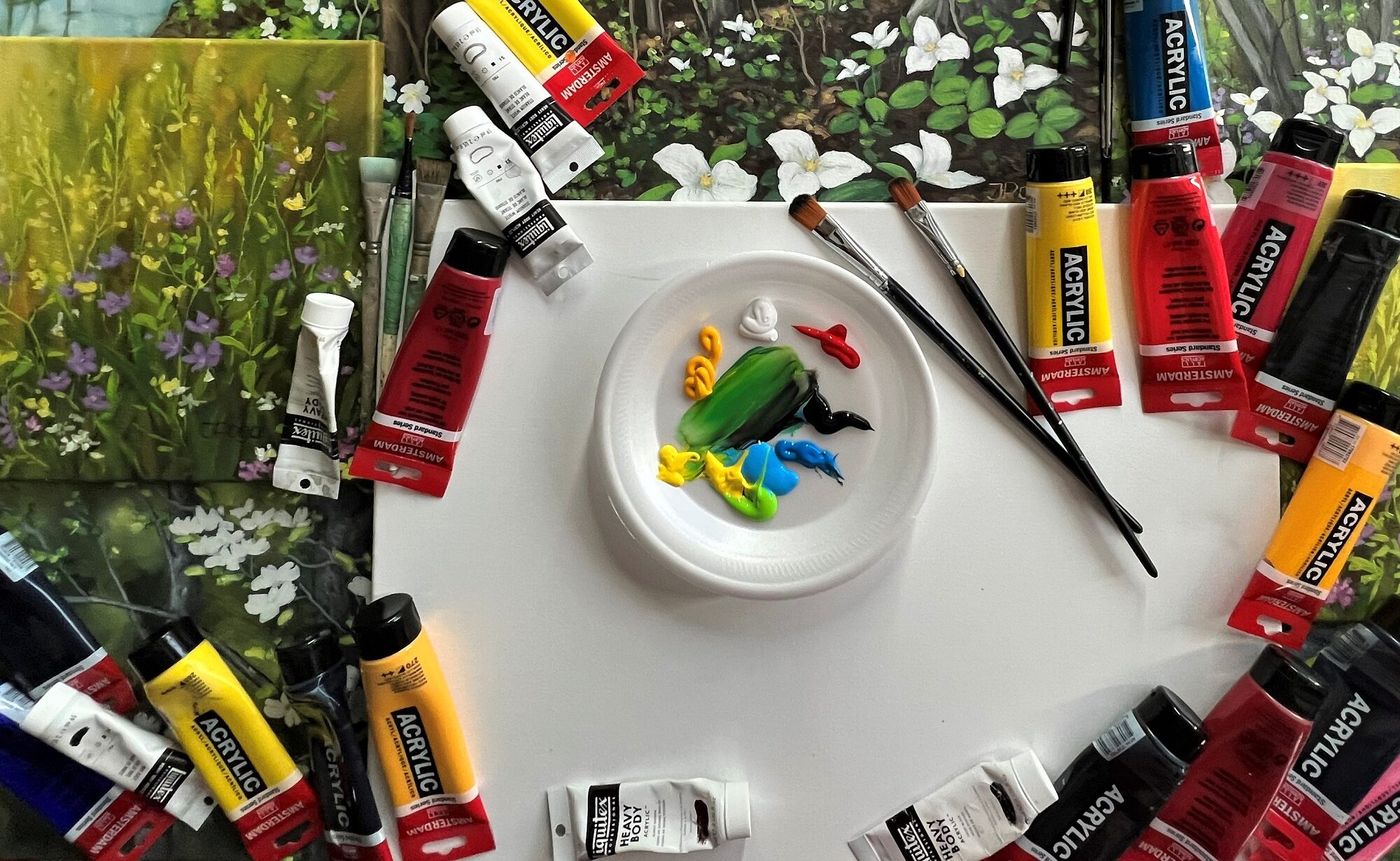
The best acrylic paints for beginners are AMSTERDAM students’ grade or Liquitex Basics students’ grade paints. Artist’s Loft (Michael’s brand) will work, as well, but it doesn’t mix well with paints of other brands (curdles).

The best is to get a professional grade Titanium white and two yellow colors: one lemon yellow and the other cadmium medium yellow or similar warm yellow. White and yellow are very weak colors in any students’ grade paints. I’d not advise to get a paint set, but rather separate tubes because we use white and yellow much more than other colors. You do not need any green color..

Short list of acrylic paint colors:

You will need 6 basic colors to get started:

White: Titanium white, required more than other colors

Black: Lamp black, Mars black

Red: 1 warm red (more orange red) and 1 cold red (more purple)

Cadmium medium red, Primary magenta, Crimson pyrrole, Carmine red, Crimson lake, Carmine lake, Naphthol red medium or similar, whatever red the brand you want to use has.

Yellow: 1 cold yellow (greenish shade), 1 warm yellow (more orange shade)

Hansa or Lemon yellow (cold yellow) and Cadmium yellow medium, Brilliant yellow, Azo yellow medium (warm yellow)., 2 yellow shades are important for color mixing. If you have just one, please, choose medium yellow (warmer).

Blue: Brilliant blue, Prussian blue and/or Cobalt blue, having at least 1 blue is very important

Artist grade paints have more pigment and less fillers and binders. If you would like to use artist’s grade paints, I would advise Liquitex heavy body, Graham (satisfactory quality, not that great tubes) or Golden (also tough to open tubes).

Additional acrylic paint colors:

You can get them gradually when you know what you need more.

Ocher: yellow ocher or golden ocher

Red-brown: Burnt sienna

Warm dark brown: Burnt umber

Blue: Ultramarine blue, Cerulean blue

Dark grey: Payne’s grey

Additional supplies: white plastic disposable plates (it is important plate is white). Do not use mixing papers or tiny palettes which are not suitable for mixing wet paint. I will not accept them for art classes. Mixing paper does not work with many acrylic paint applications, especially fan brush and sponge.

At least 10 sheets of paper towel per class. It is very important you use paper towel, it is not possible to paint without cleaning your brush frequently.

We use pre-painted canvas so that painting is much easier.

Additional supplies for easing the painting process

Plastic knife

Seaweed sponge or silk sponge

Slow-drying medium and blending medium, as well as modeling paste are useful, but we use them only for certain projects and get by with water. I have my own blending medium which I create from 3 components, I will show how.

It is better to have fewer acrylic painting supplies and better quality supplies. It is recommended to get paints at the art store. Artisan liquid paints from the Dollarama absolutely do not work.

Schedule:  Art classes, schedule and registration

Mastering watercolor painting

Mastering watercolor painting, art classes

Mastering watercolor: it is a journey

You can expect a lot of learning; a lot of practicing and you will definitely find out something which you did not know before if you would like to paint with me. I take a lot of pride in boosting one’s creativity as opposed to mechanical copying and using paint without any knowledge. Along with nature watercolor and acrylic painting, fall art classes will be an ongoing journey into creativity, and hopefully result in some students mastering watercolor.

Nature art: a wonderful opportunity

Our eyes best notice what is around us if we focus, pay attention and observe. Fall colors are intense and make any composition look impressive. We have created numerous fall watercolors before, and they always came out nice. Acrylic definitely is a very suitable medium for depicting fall scenes, especially with grey and blue colors of sky.

Democratic nature of art

This season, fall art classes are designed to better suit teens 13+ years, and the evening group is for any age adults and youth. Art is very democratic: one works on their own canvas or paper, and nobody cares whether you have experience or not. Art classes are for learning. If you have never painted before, allow this skill some time to develop.

Online versus live art classes

When you are sitting on one side of screen, nobody can check or see how exactly you are applying the advice or tip. In a live art class, the instructor can see right away whether the paint is too wet, too dry, student uses too little of paint or there is way too much of it. The instructor can see right away who understood the technique and who is struggling with it.

Inese’s Art Studio has new location

Inese’s Art Studio has moved to Ajax at the beginning of August. It is a beautiful place with indoor and outdoor painting opportunities. Its location is perfect since it is quite central, but offers fantastic nature all around. I hope you will sign up and enjoy our fall art classes.

Schedule, registration and more info about art classes: Sign up here


How to use manually created art as a memory boost

How to use manually created art as memory boost

How to use sketching and drawing to improve our brain fitness

Manually created sketches and drawings can really help. I will try to explain how and why we should use this approach to improve the brain fitness and cognitive abilities.

Manual sketching, drawing or painting when done from real scenes and subjects use our brain efficiently, create new neurons and signal pathways since these activities are challenging, interesting, new every time, rewarding and pleasurable. When done in a group, it also gives one chance to communicate, learn new skills and achieve real meditative state of mind which in turn relaxes and calms.

I am somebody who always reminds: use your brain, keep it flexible, well-functioning and young. Therefore, I am always inviting people to join our drawing, sketching and pen and watercolor classes. There is nothing to lose, plenty to gain.

Artificial intelligence and human brain capacity

The artificial intelligence progresses very fast. It feels there is some new gadget, device or app every day. Artificial intelligence is supposed to make our life easier and more comfortable. We are required to memorize less, to decide less, to search our personal brain storage less because everything is on the internet. We do not have any need to remember or write down things that are important, and we are actually losing the specific ability and muscle groups to use our hand for manual writing or drawing. Fine and extremely accurate movements still matter, so does our ability to perform them. However, the performance of our brain is the factor that matters most.

What happens to our own intelligence?

As somebody who works with people and teaches, I can see that the human intelligence suffers actually a lot. Just in the last 5 years while everybody has been actively using mobile devices, I have noticed significant decrease in attention span, focusing ability, memory and ability to make decisions. All these features are significant brain and cognitive function markers. It feels that AI has a huge boost, but the human intelligence cannot keep up with it. People are getting forgetful, losing focus and their decision-making skills.

Manual drawing and sketching as prevention of memory loss

One of things we still can do, do easily and everywhere is drawing and painting manually by using our own visual perception. We should try no to depend on any devices while engaging in this activity. That is recognized as one of the best ways of keeping our brain sharp and flexible and cognitive function well performing.

Potential benefits

One to two times a week drawing outdoors is beneficial in all possible ways. Who knows that better than me? Time flies and I have created something to show for while being outside and enjoying nature. Small backyard birds are also an excellent subject: lovely, friendly and always around. It might be not that easy to always catch the right view of a bird, but still, – nobody is going to judge. If it comes out great, share it, if it requires more practicing, keep it as a learning experience. And enjoy your memory boost!

It is not that everybody is going to get involved in serious and time-consuming research or high difficulty grade studies which certainly are memory boost, brain flexibility and power. Language learning is a fantastic way of making brain younger again, but it is a very lengthy process before one can really see good results. I know that, too, because I speak at a native level 4 languages. Each one requires a lot of additional work and studies. That is a life-long process.

Overcoming fear of getting involved with a new activity

Much faster and simpler, as well as much easier memory boost is drawing and sketching. Some people start keeping an art journal if they prefer small forms, and that is such an adventure on its own. That, too, will be your memory boost.

Some people worry that they need to do a lot of preparation work before they engage in either drawing or sketching. That is not true. One has to start somewhere, and that is an excellent starting point – from zero. It means actually that there is a whole lot to explore, find out and enjoy. The only thing one should be not hoping for is to become a master within a few hours or days. Years might sound just about right, but who says one has to be a master or professional in order to draw, sketch and paint? I know fellow bloggers who do it for their own pleasure or to have good time.

Some of my pen and watercolor paintings that deal with perspective lines and involve man-made structures

Buildings make a superb subject!

We start with drawing, and I intend to publish guiding materials for drawing and sketching.

Here: making the drawing more visible with washes

This pen and watercolor painting is ready!

The pencil helplines are erased, but using them makes creation of black pen drawing easy.

More watercolor washes, here and there, and the painting is ready

My advice is: just do it! Along with creating art, it will serve as memory boost. After a while, you might have a new attitude towards many things, as well as see how well this is working for you. Good luck!

Link to drawing:  Engage in drawing and watercolor

Link to art classes: Application for art classes