Enjoying spring nature and presence of painting subject

Old barn, spring painting in acrylic

Spending time with spring nature

Spring is already here. Art studio is a place which is always in bloom. Art studio has all seasons at once, and spring is presented to a high degree. Spring also means, one can take a canvas or sheet of paper and head out to be closer to the big awakening. Spring nature is an excellent subject! How much time do we really spend in nature and with it? Only with nature, without checking your phone or texting, or listening to music instead of bird songs? The research finds that it is a very insignificant amount of time compared to what we spend in a car and indoors. So, head out!

Outdoor drawing and painting

Outdoor drawing allows not only being close to the nature, but also experiencing a great presence of our subject. Many people use plants, flowers, leaves, blooms, trees, and other live natural subjects in their art. Being able to create a good reference drawing comes from observation. Outdoors is the best place to observe all growing and blossoming things and to understand how they change along with seasons.

Being close to the painting subject

Outdoor painting teaches us how to use fewer art supplies, but use them more effectively. Being in a close distance to our painting subject and having a chance to observe it is an extreme bonus. All tracing and photo editing software can never compare with direct observation. It is because of the presence. Any painting you do using real things and looking at the real painting subject will look more convincing. We can definitely feel the presence of painting subject or lack of it in the finalized art.

Direct observation and drawing

I feel that my duty is to teach other people enjoying things which are not costly, but rather a true source of happiness, pleasure and satisfaction. It would be tough going through life without art and beauty.

Daily drawing practice

We can keep our brain flexible and our cognitive function in great condition by simply drawing and sketching every single day. Just like you go to the gym, you need to engage your brain to its capacity with pleasurable things like art even when out of work and school. Observational drawing and painting is number one brain booster.

The best medication for mental issues

Drawing and painting are the best medication for any trouble, but especially mental issues, such as depression, grief, persistent, obtrusive thoughts and anxiety. We shouldn’t ignore the importance of new and challenging activities as brain fitness exercise. While one paints, they also completely forget about things they are addicted to: food, snacks, alcohol, drugs, smoking and devices, as well as phone. This gives us the much-deserved break from mind pollution.

The immediate result of painting is not the ultimate goal

It is often assumed that the only goal of drawing and painting should be the immediate result. We should not forget that here is so much to gain from the process. If you stop being concerned about the result, you will find out how rewarding the process is. Everybody achieves good results if they practice and keep painting, but certainly the process of creation is the one that deserves to be finally acknowledged and considered the main part of creativity. Along with feeling relaxed, trouble-free and happy, you will also create art that becomes better and better over time.

Picture taking

I tried to take pictures side by side, just to keep colors more relevant. My phone camera has too much contrast and my pictures come out extra bright. They have strong dark contrast which is not present in art. The real paintings are well-balanced. That is a good reason to make a trip to my art studio.

It’s not only color which is not true on photos, it’s also contrast, but especially the size. Size makes a big difference, but it is impossible to see that on the internet.  Everything from very large to very small art will seem to be the same size.

Spring, barn Nostalgia series, 24 x 20 inches, or 61 x 51 cm, acrylic on canvas

Anyway, enjoy the new art, and you are welcome to attend my popular art classes.

My art products and prints of paintings on Fine Art America:

Art collections by Inese Poga

Watercolor flowers: serenity and hope

Beautiful rose painting, watercolor paintings for sale

Sad as I am today, I can only paint some flowers.

Sometimes I can forget the reality and sometimes it is too persistently reminding that nothing is going to be as it was.

I did not have any energy left to sign the most current flower painting yet, but it is watermarked.

I look at this painting and think about spring and things that won’t be the same.

We are always in a different place in space. We travel so fast it would be strange to hope things never change if everything else does.

To me, painted flowers are like music to eyes.

Poetry to mind.

Water to the desert.

Hope in hopeless moments.

Beauty when everything is frozen and dark.

Light in the middle of the night.

11 x 14 in (28 x 36 cm), watercolor on Arches watercolor paper.

I hope you will love it.

Other recent flowers: Roses from me to you

Some more:  Pink watercolor flowers

Be curious, be creative

Be curious, be creative

Our natural artistic abilities

Children can draw and paint before they are able to speak and anybody can still draw and paint even if they have lost many other abilities. We can express ourselves through art naturally. It is just so that when kids grow up they frequently get engaged in devices and digital devices, as well as they believe there is no more time for art.

Brain fitness

The comparative research in brain fitness and memory boosting activities clearly showed that doing manual observational drawing and painting 2 times a week for a few hours grew the most new brain neurons and wired the brain in the way that it was much more active than with any other activities. Drawing and painting were compared with reading, writing poetry or fiction, researching internet and writing down discovered things, doing mind games and crosswords.

Outstanding visual memory and decision making

My personal experience is that observational drawing develops extremely good visual memory, not simply good and flexible memory, but outstanding memory which does not worsen over time and with age. Drawing and painting boost attention and focusing ability to a high degree, and most importantly, one becomes master decision maker because that is what drawing and painting is. Every single brushstroke and line is based on numerous decisions. At least, it should be. The memory improvement occurs when we absorb the subject visually, and our brain sends a signal to the hand with brush or pencil . That is also active brain exercising.

Style, decisions and originality

Curiosity and necessity are frequently the main driving forces of discoveries. Creativity is the base for any solution we find along the way. Since anything we create must originate in our personal perception and be based on our own decisions, one cannot ever learn drawing or painting by watching somebody else do it. As they paint or draw they make decisions which we are unaware of.

Be curious explorer

I have noticed the following. Most people who are about to attend art classes have new art supplies: new paint tubes, new sets of paints, new brushes and new paper and canvas. Everything is unopened and not used. The first time they open their paint tubes is in the classroom, therefore, nobody knows what their paints and brushes are like. It seems surprising to me. How do you know now what that particular paint or brush will do? We should start with exploring what we have.

Quality or lack of it

We have numerous art supply manufacturing brands nowadays. Some are fine, but some sell such bad quality paints, brushes or paper that it is hardly possible to use them. Just like with many other products, art supplies often will be: “you get what you pay for”. That is why you should always test everything.

Curious as a kid

Look at kids what they do with a new box of paints, pencils, markers or crayons! They open it as soon as they can and start using immediately. Kids are curious and they are creative naturally. What is stopping adults? It is hard to say, but they should try being as curious and as creative with their new art supplies.

Testing art supplies

I am strictly advising: test every color, test every brush, test every paper and canvas. Do it before the class. Open every tube and paint some areas with every paint color in your set. At first, we do this using each color separately. For watercolor, we add more water, then less water to see what range of tones each particular color gives. For acrylic, use a small bit of water and wash the brush with warm water and soap afterwards.

Testing two colors

Next step is to test two colors together, for instance, every other color with blue, then every other color with yellow, then every other color with red. Larger sets will have many blue colors, many red colors and at least 3 to 4 yellow colors. That gives you numerous shades and transitional colors. That will also allow seeing what exactly you have. Be curious, be creative and that will allow you to start out easier.

Creating your own color swatches

It is not important to use any color charts or wheels, but it is important to know what the colors you have are and how they behave when mixed. Create color swatches from all tubes you have. Add to mixed color swatches. That way you know what you have, what it looks like and whether it is worth using it.

Testing watercolor paper

It is very useful to test the watercolor paper, as well. We will have different results with different paper. Some papers buckle a lot and some won’t allow applying more than 2 washes. You need to know what your paper does when using water on it. Brushes are also not the same. If you test your brush and it absolutely does not perform, it is quite clear that you’d need a different brush. We only use 2 brushes for either watercolor or acrylic at the beginning.

Some of 2018 watercolors

Being curious and being creative will make art happen

Being curious and being creative is always helpful when doing art. It is so much better to discover your own favorite colors and color mixes than to just blindly follow some rules, charts or somebody else’s favorites. Be the creator of your own style. I am personally against rules in art. We need at least some areas in our life which are free of strict regulations and rules. Art can be that area if you give your imagination  space.

It is New Year. Maybe you have lots of new art supplies. Don’t wait to explore them. Always be curious and be creative, try them now. Thanks for reading!

Link to art classes schedule: Sign up here

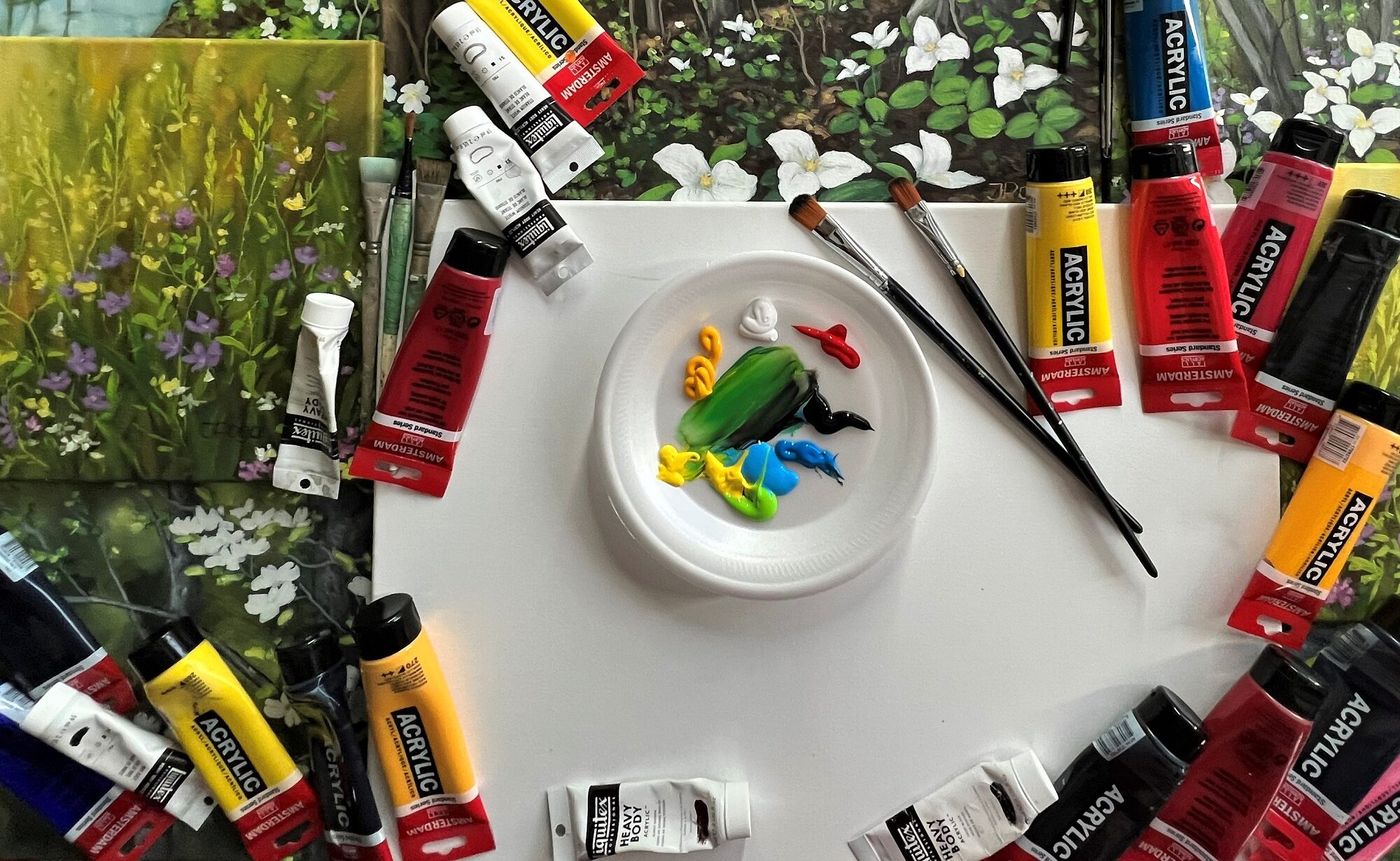
Acrylic painting supplies for art classes

Painting supplies for acrylic painting classes

We do not need a lot of acrylic painting supplies to start painting, so, keep the list short and get things you do not have yet as you go.

Brushes

1 flat brush, soft, synthetic for either watercolor or acrylic painting, ¾ inch wide; or about the same size Filbert brush (it is flat with rounded corners). 1 small soft watercolor or acrylic brush, size 4-6 round, fan brush for oil painting (rough bristles). If fan brush with rough bristles is not available, get simple wall/window painting brush, 1-1.5 inch wide. We will cut it out with scissors, so that it can do more. I will show how.  We can use Filbert brushes (slightly rounded edges) in small to medium sizes also.

Canvas

We use 16 x 20” canvas for regular classes and 16 x 12″ canvas for 1 day workshops. If you believe you are rather slow with brushing paint, the smallest size is 12 x 16 in. However, painting larger is easier. You will need to paint your canvas in medium dark grey or brown color before you come to class. The edges of canvas need to be covered with one layer of paint as well. That helps creating better art much faster.

Acrylic paints

The best acrylic paints for beginners are AMSTERDAM students’ grade or Liquitex Basics students’ grade paints. Artist’s Loft (Michael’s brand) will work, as well, but it doesn’t mix well with paints of other brands (curdles).

The best is to get a professional grade Titanium white and two yellow colors: one lemon yellow and the other cadmium medium yellow or similar warm yellow. White and yellow are very weak colors in any students’ grade paints. I’d not advise to get a paint set, but rather separate tubes because we use white and yellow much more than other colors. You do not need any green color..

Short list of acrylic paint colors:

You will need 6 basic colors to get started:

White: Titanium white, required more than other colors

Black: Lamp black, Mars black

Red: 1 warm red (more orange red) and 1 cold red (more purple)

Cadmium medium red, Primary magenta, Crimson pyrrole, Carmine red, Crimson lake, Carmine lake, Naphthol red medium or similar, whatever red the brand you want to use has.

Yellow: 1 cold yellow (greenish shade), 1 warm yellow (more orange shade)

Hansa or Lemon yellow (cold yellow) and Cadmium yellow medium, Brilliant yellow, Azo yellow medium (warm yellow)., 2 yellow shades are important for color mixing. If you have just one, please, choose medium yellow (warmer).

Blue: Brilliant blue, Prussian blue and/or Cobalt blue, having at least 1 blue is very important

Artist grade paints have more pigment and less fillers and binders. If you would like to use artist’s grade paints, I would advise Liquitex heavy body, Graham (satisfactory quality, not that great tubes) or Golden (also tough to open tubes).

Additional acrylic paint colors:

You can get them gradually when you know what you need more.

Ocher: yellow ocher or golden ocher

Red-brown: Burnt sienna

Warm dark brown: Burnt umber

Blue: Ultramarine blue, Cerulean blue

Dark grey: Payne’s grey

Additional supplies: white plastic disposable plates (it is important plate is white). Do not use mixing papers or tiny palettes which are not suitable for mixing wet paint. I will not accept them for art classes. Mixing paper does not work with many acrylic paint applications, especially fan brush and sponge.

At least 10 sheets of paper towel per class. It is very important you use paper towel, it is not possible to paint without cleaning your brush frequently.

We use pre-painted canvas so that painting is much easier.

Additional supplies for easing the painting process

Plastic knife

Seaweed sponge or silk sponge

Slow-drying medium and blending medium, as well as modeling paste are useful, but we use them only for certain projects and get by with water. I have my own blending medium which I create from 3 components, I will show how.

It is better to have fewer acrylic painting supplies and better quality supplies. It is recommended to get paints at the art store. Artisan liquid paints from the Dollarama absolutely do not work.

Schedule:  Art classes, schedule and registration

Mastering watercolor painting

Mastering watercolor painting, art classes

Mastering watercolor: it is a journey

You can expect a lot of learning; a lot of practicing and you will definitely find out something which you did not know before if you would like to paint with me. I take a lot of pride in boosting one’s creativity as opposed to mechanical copying and using paint without any knowledge. Along with nature watercolor and acrylic painting, fall art classes will be an ongoing journey into creativity, and hopefully result in some students mastering watercolor.

Nature art: a wonderful opportunity

Our eyes best notice what is around us if we focus, pay attention and observe. Fall colors are intense and make any composition look impressive. We have created numerous fall watercolors before, and they always came out nice. Acrylic definitely is a very suitable medium for depicting fall scenes, especially with grey and blue colors of sky.

Democratic nature of art

This season, fall art classes are designed to better suit teens 13+ years, and the evening group is for any age adults and youth. Art is very democratic: one works on their own canvas or paper, and nobody cares whether you have experience or not. Art classes are for learning. If you have never painted before, allow this skill some time to develop.

Online versus live art classes

When you are sitting on one side of screen, nobody can check or see how exactly you are applying the advice or tip. In a live art class, the instructor can see right away whether the paint is too wet, too dry, student uses too little of paint or there is way too much of it. The instructor can see right away who understood the technique and who is struggling with it.

Inese’s Art Studio has new location

Inese’s Art Studio has moved to Ajax at the beginning of August. It is a beautiful place with indoor and outdoor painting opportunities. Its location is perfect since it is quite central, but offers fantastic nature all around. I hope you will sign up and enjoy our fall art classes.

Schedule, registration and more info about art classes: Sign up here