Landscapes which live in my memory

Spring painting, spring creek

Places where I have spent most part of my life, do not stand out with spectacular landscapes. I don’t usually paint mountains, oceans, seaside or waves. I’ve seen them, but I have hard times recalling such views in detail which is necessary for creation of painting from memory. Many of these paintings were also started a long time ago just as a demo for my live art classes. That means, I’ve spent very limited time painting them during the class. My main focus was what students learned from each process and less an attempt to create a masterpiece.

Therefore, I had to change some parts, add finishing touches, increase strong values, add strong highlights, refine some details and mask out some other parts. These landscapes are views from my memory and imagination, they might or might not exist, but I usually want the subject to be recognizable without long explanations. I suppose, I’ve said it quite a few times that I’m not thrilled about small size, like 16 x 20 in or 41 x 51 cm paintings of complex views and detailed subject. For me personally, the most comfortable size for acrylic is approximately 30 x 24 in or 76 x 61 cm and for watercolor: full sheet which is most often 30 x 22 in or 76 x 56 cm. Such size allows implementing aspects which are very important in painting: decent values, decent size subject, powerful color switches and a few outstanding details.

The current trend of displaying paintings in clusters is a great one. Even when painting is large, it takes a lot of design skill to make it rather become a part of space than dominate it or disappear in it. Clusters of paintings suit any taste and allow using paintings of small and medium size, too. They do change the mood in room, they can take you to any season or make feel happier in your space. I am not allowed to hang much on walls in my rented space. We tried strips and some of bigger paintings fell down. I didn’t even attempt hanging the huge and large watercolor paintings that way.

The history and story behind these paintings is the same, but some are pretty much painted from new. You can do that in acrylic, no problem. In fact, I think acrylic looks better with numerous layers, – the more, the better. Colors become intense and also change in different light settings, the most dramatic parts become textured and that looks really adorable. These paintings have taken weeks to accomplish letting dry between layers. I know how little of that is visible in an online image, but the presence is still there.

Since I spent 46 years in Latvia and it’s not even twenty in Canada yet, the subject of my painted landscapes is associated most often with Latvian countryside, Latvian country roads, gardens and plants, as well as with nature in Latvia. The area around Ajax where I live now is similar, but I would never paint the local box-like boring buildings which really offend one’s esthetic principles. That’s why we have imagination and can travel back in memories to any season, any place and any emotion that provoked.

Other than that, I’m finally working on compiling a book of acrylic painting techniques for landscapes, still life and floral art. It is a slow process, and it probably will take numerous hours for creating more pictures, describing tools and efficient process steps, as well as basic principles of painting in any medium since most of them are the same. Creating art should never be struggle, that’s why I will also keep teaching live art classes when we reopen. That might be in July, or August, or September.

Thanks for reading, enjoy!

My art store is not coming along swiftly as I hoped, so for prints, please, go to Fine Art America:

Art collections by Inese Poga

Spring flowers are in bloom at the studio

Soft yellow spring daffodils

While the weather is still changing swiftly outdoors, my studio blossoms in full force. Spring flowers are in bloom!

Art is timeless, it can easily survive us. Art is a gentle reminder that we never know everything and we are here just to learn and to give our skills to others.

We are adding new projects practically weekly, and I am finalizing some paintings at least twice a week. Light is great during the day and days are becoming longer, too. I am not sure how much brighter the light should be for video recording. It is very sufficient when painting, but for video recording it is still not enough as it appears.

Doing is better than watching

My personal point is, nobody has ever learned anything by watching others do it. We can either paint or draw, or watch others paint. It’s pretty much so that we cannot do both at the same time. I would say, if you want to learn, just go for it. Everybody damages many watercolor papers and paints over previously painted canvas many times and until they manage to use the brush properly, as well as understand what colors they like and how to create them.

What is important

It was never about how to paint or draw an apple, or one particular flower, or one particular landscape. Painting and drawing is a skill which follows certain principles and teaches one to become efficient with decision making.

No need to be afraid

It is silly to be afraid of damaging paper or canvas. While we learn, we are in process of discovering so many aspects of our subject. This is a path which involves many sideways and much blundering around until we find the right way for us.

White and yellow daffodils, watercolor

Trillium forest, watercolor on paper, one of my recent watercolor painting projects. It is so lovely to paint fresh greens!

This was an amazing project, and we really enjoyed creating dark background around the white blossoms.

More spring flowers from previous projects

That’s what I do every spring: disappear in flowers until it is time to start digging and planting seeds in the soil.

Enjoy the spring blossoming and lovely colors of flowers. This subject really works well using any medium, but especially watercolor, thanks to speed and fast coverage of large areas.

New art prints on Fine Art America: 

Art collections by Inese Poga

Apply for art classes: Sign up here

Copyrights of the displayed art belong to artist Inese Poga. Please, do not copy, or use, or place images of my art on any other websites without written consent from Inese Poga. See full Copyright notice on the widget area.

My magic watercolor brush

Fall leaves, watercolor

Every paint brush becomes magic once we learn how to use it properly.

It’s how you use the brush

It matters how much pressure we put on the brush and what part of it we use. It matters that you use specifically watercolor brush for watercolor. Watercolor brushes are soft and able to hold plenty of water and paint. While the shape of brush matters, too, the most important part is still how one handles the brush. If you just try to aimlessly move some paint around the magic brush loses its ability to create something great. I usually use only a few brushes for every medium, most often just one or two.

My preferences for watercolor brushes

For watercolor, I use number 14 round, soft watercolor brush with a very fine tip mostly. Therefore, it performs quite a few functions. When we hold it perpendicular at a 90° angle, we can draw very thin lines. Since this brush holds a lot of water and pigment which is important for watercolor, we can use the side of brush parallel to paper and cover large areas fast with either water or paint.

Time it right

Timing is also important for watercolor. We can use just part of a large brush and move paint around. We can use full body of a big-size round brush and cover large areas of paper fast. We have to time everything accurately; if you want fine details, you will do them on dry paper. If you want smooth washes and color transitions, you most likely will wet paper first. Wet paper is also safer for those who are slow with paint application. That will allow avoiding streaks and patchy paint spots.

Fall colors

We have beautiful fall weather at the moment in Southern Canada. Leaves are turning golden, red, orange and purple. It is a good time to practice color mixing and color application since inspiration is everywhere. Bright, sunny and golden colors shine on grey and blue backgrounds. Use that in your favor when creating fall paintings. I started the painting of fall leaves a few years ago for watercolor painting class and finished just yesterday.

The most recent watercolor painting class image

This a quick watercolor painting without drawing and applying rather washes. Mine was done on not that great watercolor paper, but it still makes a lot of sense. Not to mention, that real painting always have more balanced colors and look way smoother than extra sharp iPhone pictures.

I hope you enjoy these paintings.

To sign up for art classes, please go to page:

Art classes, schedule and registration

All my art prints and artistic products:

Art collections by Inese Poga

Summer sketchbook: easy flowers

Summer sketchbook, watercolor painting of poppies

Fill your summer sketchbook

This year, I am filling my summer sketchbook with floral art. Watercolor sketch, pen and watercolor or purely watercolor are excellent ways to paint summer scenes, summer flowers, summer landscapes and simply enjoy the outdoors and beauty. The easiest way to practice painting with watercolors is using pen and watercolor wash, that will fill your sketchbook in no time. That enables us creating great composition and not caring too much about pencil lines and perfect application of watercolor.

Summer poppies, 12 x 16″ or 30.5 x 40.5 cm

Excellent technique for beginners

Pen and watercolor wash is a great technique for beginning watercolor artists. The most exciting part is adding watercolor washes, as well as more detailed areas with more concentrated paint. We can create a wonderful painting in less time this way because we do not need multi-step drawing transfer onto watercolor paper. It is also much easier to know where to use paint because the black outline clearly identifies that.

The spring rose, 15 x 11″ or 38 x 28 cm

Greatness takes time

If you are new to a particular medium or absolutely new to drawing and painting, you have to remember: nothing happens right away. Every skill takes time, efforts and work to develop.  It is no reason to give up painting or drawing if you are not happy with the first few drawings and sketches. You might be surprised how much better one becomes after a while.

Sunflowers, pen and watercolor, 12 x 16 in or 30.5 x 40.5 cm

Not every painting is masterwork

Focusing on perfection right away will cause you to be disappointed. Any artist will tell you that they have damaged, and thrown out lots and lots of initial sketches, painted over initial scenes, changed the layout and composition completely, switched to a different color or tools. They have done many things before they have created the first amazing painting. Not every drawing or painting is or should be a masterwork. It should be a stepping stone on our way to better art. We use our errors as a way of discovering how to achieve what we want and have intended.

Red poppies, pen and watercolor, 11 x 14 in or 28 x 36 cm

For your inspiration

Get inspired by my simple pen and watercolor sketches. This time, they are floral sketches and paintings. Go outdoors; see what you have in your backyard. Sketching is always better if you do not use any photos, but the real thing in front of you. Pen and watercolor technique allows achieving fast results, therefore, your subject will not change while you draw and sketch it.

Clematis, pen and watercolor, 12 x 16 in or 30.5 x 40.5 cm

Art supplies for drawing and sketching to fill your summer sketchbook

CANSON XL cold press, 140 lb watercolor paper, size 12 x 16 or 12 x 18 in

Arches, cold press, 140 lb watercolor paper, size 12 x 16 or 12 x 18 in

Saunders Waterford, cold press, watercolor paper in whatever weight is available and affordable, size 12 x 16 or 12 x 18 in

For pen, you can use any black pen which does not bleed with application of water. I recommend MICRON brand which contains archival ink, size from 1 to 05, test it. You can test it at the store for thickness of line before buying to see which one you like.

Graphite pencil, HB or even harder

Soft, kneaded, artist’s grade eraser, it is sold in art stores.

Paper towel, a few sheets

Set of watercolors in basic colors

All my art prints, art cards and other products on FAA:

Art collections by Inese Poga

If you’d like to sign up for my art classes, please click on link Art classes

Private art classes: Take a private art class

Art for sale: Shop Inese’s art

Spring paintings in acrylic

Old weathered barn in spring landscape with yellow daffodils

Spring paintings feel like a good choice when nature awakes

When else if not now to engage in creation of spring paintings? One can tell how much I love spring by just having a look at what I have painted recently: spring flowers, spring scenery and spring landscapes. I think I feel seasonal changes on a mental level very strongly. I cannot imagine I would be painting snow right now. Still life in that regard is the most neutral subject, but I felt I needed something more impressive.

My personalized realism

Most people believe I paint reality, but I do not. I use quite frequently real things, like I used real daffodils for the front part this time; however, I always beautify the reality and make any subject my personal reality. That means I give the subject my colors which I love at that moment, enhance the layout, and add extra contrasts or values, just to make everything more of what I experience at that moment.

Nature does not always cooperate

The truth is the spring has been slow again in Ontario. We even had very winter-like weather a week ago. Therefore, to facilitate the feeling of blooming and warmth, I just paint it. I decided to mostly post one image at a time whenever possible. Most people never read posts, so, they only have a glance at the featured image and move on. That is why most paintings, advice and images which are in the article go unnoticed.

Taking pictures

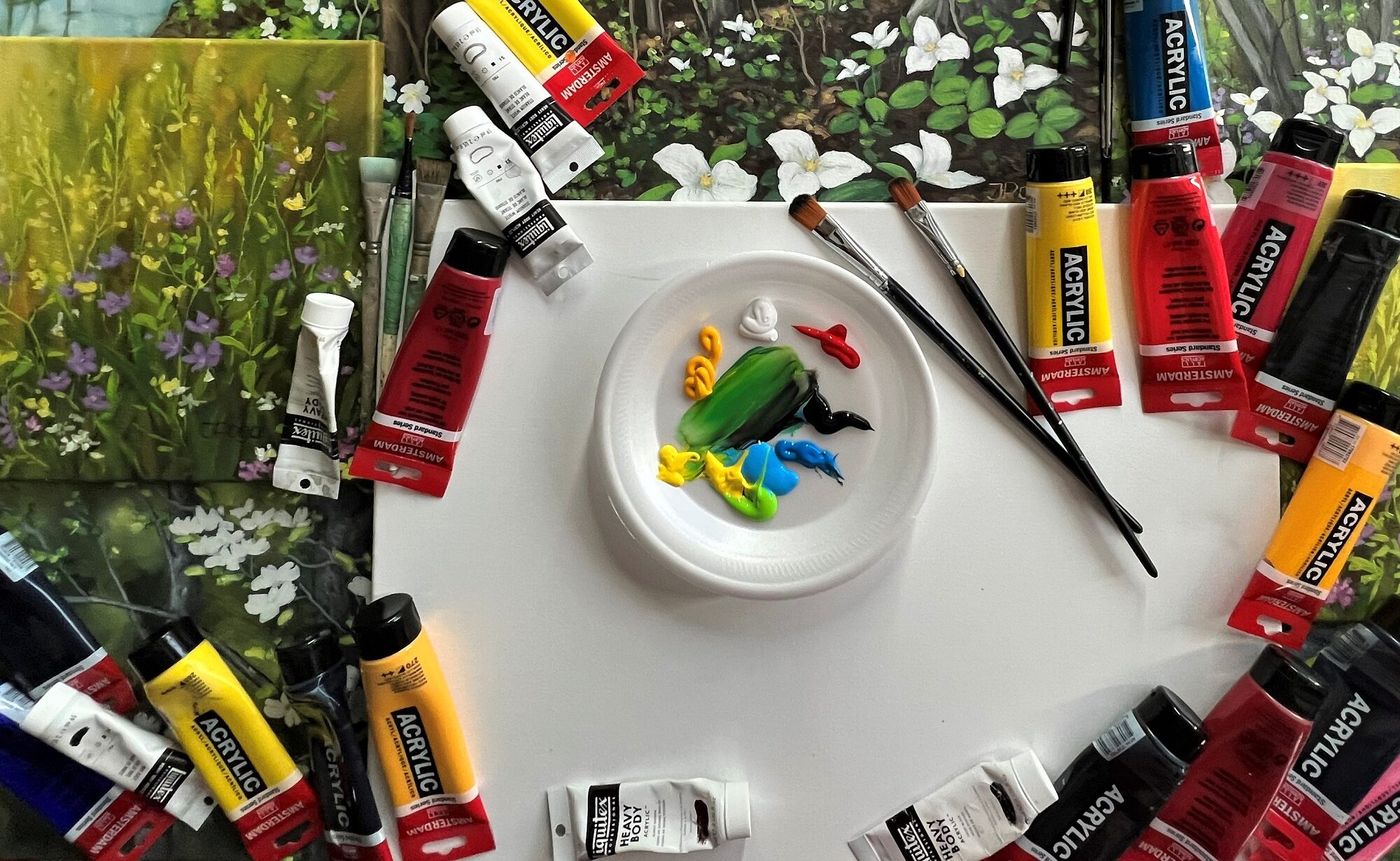
Taking pictures with iphone  is very difficult. The extreme contrast is fine for any regular pictures, but not art. My solution is taking pictures with backgrounds, extra items, paints, brushes and similar. That works for the most part, but the painting area one works on, can be very messy sometimes. I mean, there are paint tubes, dirty paper towels, plates with leftover paint, brushes, sponges, jars with dirty water and all kinds of other things. Therefore, some pictures look messy by accidentally displaying some item which completely doesn’t fit the view.

Just imagine how it looks on my wall

My pictures still display more contrast than they should. Everything is usually well-balanced in my actual painting. I work in layers and for many hours in order to achieve the color balance. As you know, acrylic paints, at least the ones which are available in Canada, become much darker as they dry. One has to calculate that in when applying paint. It can happen so that sometimes white or yellow paint is very weak, and fixing the value imbalance requires extra work.

Available for purchase

Any of paintings are available from my studio. Paintings which are displayed in this post are 16 x 20 inches or 41 cm x 51 cm. I have to mention that because pictures look all the same on the internet. Anyway, enjoy the Daffodil barn and spring paintings! Daffodil barn got lots of great comments on Facebook and Fine Art America site this time, in particular, in acrylic artists’ groups. Please, see links to other posts and FAA sales site.

Register for painting classes, including private classes, from here: Registration for painting classes

Previous post about recent acrylic paintings: New acrylic paintings

Art collections by Inese Poga