My large sketchbook and ink drawings

Winter landscape, ink drawing

Sketchbook as collection of ink and pencil drawings

My sketchbook is large 24 x 18 inches or 61 x 46 cm. It actually feels big and heavy. The tiny pocket-size sketchbooks don’t work for me. Why? If I get a good sketch and it has potential to be turned into watercolor or acrylic painting, I just trace the outline onto the respective surface. The initial sketch serves as a fantastic reference with all shadows, perspective lines and mood, as well. Much better reference than photo. As you might know, color is secondary, and values are primary when it comes to painting. Therefore, my huge sketchbook becomes a great collection of potential large size art. Some of this art is practically a finished artwork.

Advantage of ink and pencil drawing

Drawing is relaxing and it doesn’t require proper timing which is absolutely necessary for watercolor or acrylic painting because correct timing directly affects the result. For example, you squeezed out a lot of paint in order to paint for a few hours. Something happens, and the painting session is cut short. Paint dries and cannot be rescued and you will need to paint over a few areas, but sometimes – the entire surface. With ink or pencil drawing in our sketchbook, nothing dries out, nothing needs doing over, so you just pick up where you left it before. I consider this a big advantage.

Best subjects for drawing

I’ve always loved drawing buildings. And still life. Flowers are fine, as well. My huge sketchbook has numerous drawings of these subjects. For me, it’s important that I don’t need a photo. I rather construct the subject and add whatever needs adding as I go. I call that artistic freedom. I have a complete control over what I want to be on my paper. That is why my subjects often involve only things which I see around and have in the garden or house. Simple, easy and very manageable. Buildings, still life items, landscapes, flowers: they all can be made multidimensional on a flat paper.

We can do well without devices

Since technological advance has been immense, people do manual drawing rarely. They don’t have to manually write either, so the ability to re-create our idea, vision, imagination and reality is declining. The correlation between devices and use of camera is very clear when it comes to manual drawing. The more devices somebody uses to create their art, the less of observational drawing ability they have. I suppose, our brain dismisses everything we don’t engage. Why to stress out if you don’t have to?

Maybe try it

I can make these conclusions because I’ve watched how people go about manual drawing for many decades. What are their strengths and failures, how they tackle dimension, values and shapes. Devices have advanced a lot, but humans? Humans not that much. We delegate anything we cannot do well to devices since there’s a wide choice of them. However, manual observational drawing is an extremely rewarding experience. Large drawings in a big sketchbook can become the best artistic experience.

Large size makes all the difference

It’s the most fantastic feeling. We have the blank sheet of paper. I prefer large one for many reasons. We just play around and implement whatever we feel like. Using soft lines, then moving to stronger values and lines. All of a sudden, the image emerges. Just some shades of black and grey and the white of paper. That’s all it takes. Sometimes it becomes a fantastic drawing where one can literary participate in the scene. If you want to learn drawing, trust me – go big. Use the 24 x 18-inch sketchbook. Want to advance faster, draw large images. I also used Micron archival ink pen.

I hope you enjoyed this article!

Playing with green color

Green spring landscape, painting in progress

Green is a color which we feel extremely attracted to in spring. I do feel that way, and maybe you do, as well, if you’ve had many months of grey and white view out of your window. I celebrate the return of green color since it uplifts my mood and promises nicer days ahead.

There are numerous concepts and assumptions about using green in art. Many artists avoid it almost completely not be accused mixing their colors properly. Just like with everything else, it’s better to have our own take on that and experiment.

For acrylic painting, there’ s practically no need to buy green paint. Why? Depending on your personal preference, it’s possible to mix up any green shade from other colors, including three primary colors. I don’t like aqua and phthalo too much, and although, they are strong and good for cooler areas, I prefer using the quieter tones.

After 5 layers are applied on the textured background

I love black plus yellow plus touch of blue, or blue plus burnt sienna and touch of yellow. Here and there simple blue plus yellow work well. The thing is we can have cold and warm yellow and very cold and warmer blue and that changes the green we are having. Every one of colors we get has some good potential for applying it. Where? It always depends on the project, intention and technique.

After 7 layers of paint or so

It is advisable to break up the green spaces with calming tones of purple, red or cool/warm brown. My most favorite set of basic colors for spring is blue, green, grey and some warm brown, burnt sienna or white. It is a calming combination and surely conveys the concept of an artwork well.

After adding light color to selected areas

I had a 24 x 20 in or 61 x 51 cm canvas from 2015. Everything is expensive right now, and that is an extremely high-quality canvas. I cannot recall what exactly my idea back then in 2015 was, but I decided to reuse it. This canvas had quite visible textures underneath of a few layers of grey/green/blue colors. I couldn’t change the tree shapes or location dramatically, the same goes for the water patch. Therefore, I adjusted the textured image and after a few layers it started to come to life.

It’s interesting how many starting-out artists believe they’ve got to finish their painting in one sitting. That is the damaging impact of paint nights which are not art classes, but entertainment, and tutorials which use rather tiny canvas or paper. If the size of painting is quite large, it is physically impossible. Every single spot need attention and work. Acrylic paint requires timing the paint application. That means, we cover some areas very quickly and for some – we wait until the previous layers are dry. That way we get our colors to shine and shapes to work well. That translates as painting in small segments and retuning to them layer after layer.

I called this painting “The moment before”. That includes everything that happens before the nature explodes in brilliance of blooms and abundance of green in leaves and grasses. The photos are taken with iPhone and the camera of 13 Pro Max is quite disappointing. The actual painting has no real yellow in it, and the green is well-coordinated in cool and warm areas. You might not see it that way, but anyway, that’s how it is.

The moment before, 24 x 20 in or 61 x 51 cm. Enjoy!

And don’t forget to sign up for art classes: Group art classes

And look at other art for sale: Shop original acrylic paintings

Spring edition, moving art studio

Moving art studio

My art studio is moving again, indeed, it has happened so many times during the recent years. I’ve moved three times since 2018 and now I have to do that again. While it sounds quite simple, it actually isn’t. The toughest part is finding a place and qualify for it. That requires mountains of paperwork, numerous hours of printing, scanning, signing, sending documents and so forth. That is the reason I hardly looked at the internet, any social media or blog sites. There wasn’t enough time in a day to cope with all that, and nothing was left for painting, unfortunately.

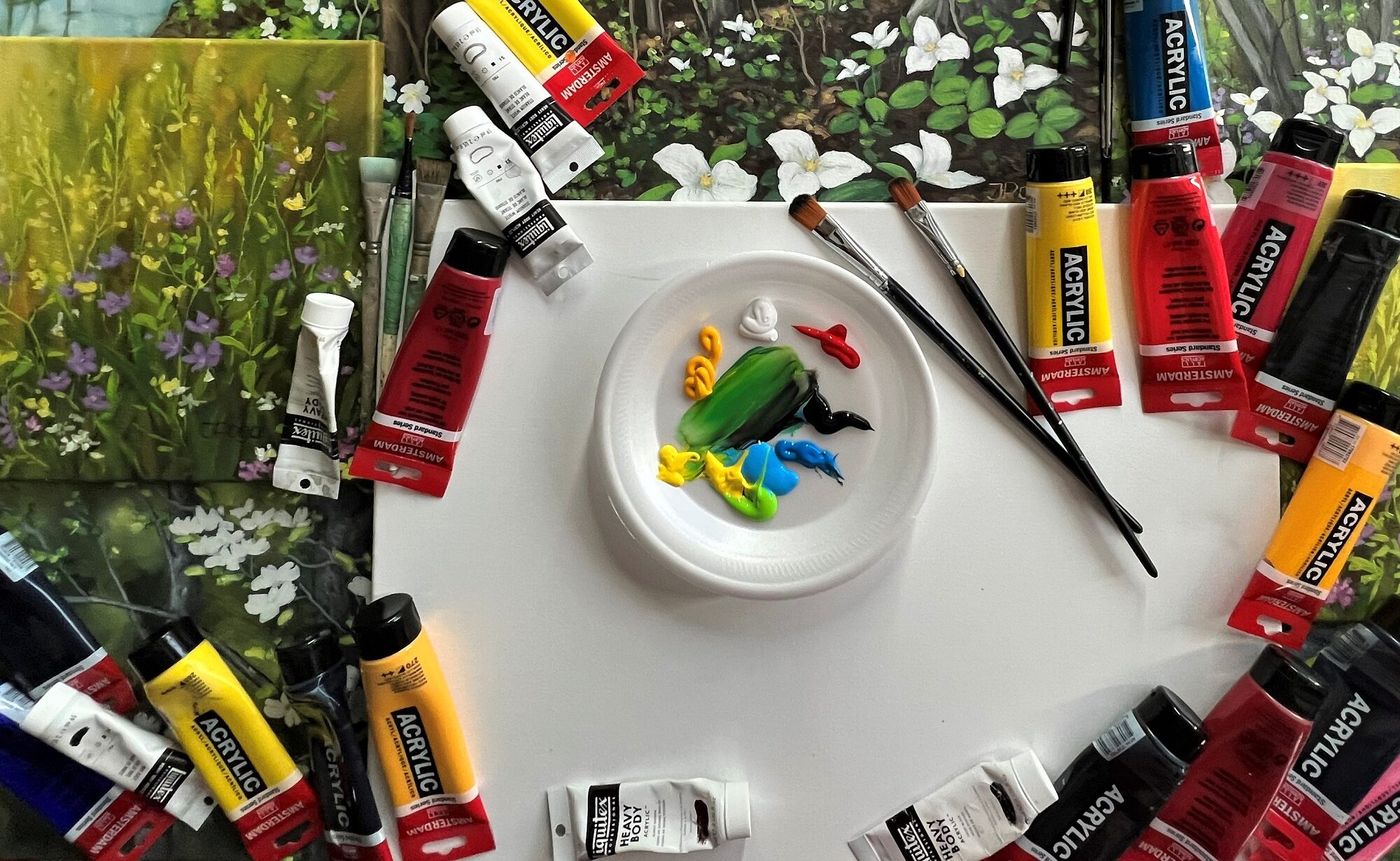
The Amsterdam paint tubes are added for color balance in photos, I use Liquitex for painting.

I did try to catch up with the artistic side, I sure did. However, that mostly resulted in wasted paint and a bit of frustration. As soon as I squeezed out acrylic paint and got in the mood for painting, the phone rang or I received a message, we have to go: to see a place, to meet somebody, to do whatever, and there was no other way around it. As you know, acrylic paint dries very fast, and even when preserving some in a tight container, it doesn’t work quite well as the fresh one.

I’m really hooked on the moment when nature awakes. The most fantastic view for me can be a tiny sprout breaking through the soil and greeting the sunshine. The first wild flowers are such a welcome sight! Strength to overcome the freeze and courage to break through impossible obstacles: that is what grasses and wild flowers have. I cannot resist, I return to wildflowers in spring settings every year.

One of my most favorite color combinations involves earthy tones, many shades of green as in sprouts, young leaves and grasses, blue patches of sky, as well as bright white, blue and pink of the wildflowers. According to such palette, I paint some knew dreamscape which I most often have seen only in imagination or which is stored in my memory chambers.

My art studio in this big house had to be adjusted and the actual painting space was sparse. As you might know from my previous posts, I usually paint only by daylight. There have been times when I have to add evenings, but I try to avoid painting at night when artificial light is required. It could be my eyesight which dictates that, but I am very sure that for true color match we need the daylight.

So, the art studio is on the move again, and I have started to pack up a few things. Very large and small paintings will be moved first, as well as part of my countless brushes and art supplies. I would love to sell a few more paintings, but I don’t have much time for advertising at the moment. We will be moving 9 large rooms into 5 rooms, only one of which is large. My art studio is going to be arranged there, in the largest room. Daylight will be much better in the new place, however. It’s an older building with large windows, lots of character and huge backyard. That is such a luxury nowadays!

My best guess is everything will be ready around April 15, and that’s when I can start with my own paintings and art classes. Until then, – I go through moving troubles, packing and unpackaging, sorting, cleaning and being busy with all kinds of things which are not necessarily art related. There will be moment when we won’t have internet yet, and when I am all set up, I will come up with my newest discoveries in painting. You can still scroll through my blog which documents all art studio moves, gives lots of advice for new and established artists and offers excellent quality art at great prices. Stay well! I’d love to hear from you!

Special art offers

Original watercolor paintings for sale

Shop original acrylic paintings

Art gifts and art prints on FAA:

Art collections by Inese Poga

Pansy smiles, once again, and new art classes

Yellow pansies, floral watercolor

Pansies, they smile for sure

My garden provides me will all painting subjects which I usually use for floral and still life paintings. I can also see quite a landscape from the second-floor balcony, so I’m all set up for any nature painting without needing to take any photos. First of all, with nowadays cameras, perspective is completely distorted, it would damage drawing or painting to huge extent. Colors are practically never true, and that is a reason good enough to rely rather on our own eyes. This time I’m presenting the new smiling yellow pansy faces surrounded by great shapes of leaves and abstracted background.

Never-ending supply of art ideas

We had big problems buying any seeds this past spring, therefore, I have mostly what grows from my own seeds and flowers and veggies which planted themselves. I got 2 sets of pansies. The one which I painted this time, was larger. It had interesting colors in the middle: not completely purple and not completely dark red in the lower part. Yellow is not that difficult color to paint as it is very annoying getting pictures of it. I can never go wrong with art ideas which grow all around the garden. It’s never-ending inspiration, always something new and more beautiful than before.

More art, less reality

When I draw or paint something, I usually change a lot from what it is in reality. I want on my painting more art, more me, more my style, and less reality. That doesn’t mean I will paint my subject in a completely abstract manner. The reason is there’s way too much abstract art already, and also – it is much easier to work on one’s style and maintain it when using recognizable and nature-like things. Pansies are a convenient subject for painting, especially when you have some around. For photo-taking reasons, I will make next painting pink or red because watercolors in such palette shades are much easier captured with any camera.

You see what you see

I regret that most of you will ever see only images of my art. I dare saying that you will never know what I and how I paint in reality. I surely can tell you that the camera made the light-yellow spaces white and caused the darker areas look like outline which they are not, I can tell that my colors are crafted and very balanced, but you see what you see. Plus, there’s no perception of size and its impact. It is again a 24 x 18 in or 61 x 46 cm painting, and that is quite large for watercolor. As it leans against the white support board, it lights up the entire studio. It’s cloudy and rainy today and this painting just shines as extra light source.

Pansy smiles, purple hearts, watercolor 24 x 18 in or 61 x 46 cm

New live art classes

After a long interruption of almost 2 years, I’m resuming live art classes in a very cozy outdoor space which is surrounded by blooming and green plants. This feature will add more safety to participants. It’s just so that I haven’t seen that many yet. To be honest, I’ve never met or had a student who learned mastering their style or medium online. I’ve written about that before: it’s one-sided, and that’s the problem. The human perception is very distinctive when it comes to any art concepts, therefore, everybody understands and applies the same thing in all kinds of ways, and rarely – correctly. In my mind, there’s nothing which can replace a real, live interaction, but that’s just my opinion. I suppose for drawing and painting animated outline drawing or extra simplified watercolor wash, anything is fine.

Real classes versus online: Compare

Mastering medium: Learn more

If you dream to become a master of your medium, you need a real art class. Apply here; Art classes

Landscapes which live in my memory

Spring painting, spring creek

Places where I have spent most part of my life, do not stand out with spectacular landscapes. I don’t usually paint mountains, oceans, seaside or waves. I’ve seen them, but I have hard times recalling such views in detail which is necessary for creation of painting from memory. Many of these paintings were also started a long time ago just as a demo for my live art classes. That means, I’ve spent very limited time painting them during the class. My main focus was what students learned from each process and less an attempt to create a masterpiece.

Therefore, I had to change some parts, add finishing touches, increase strong values, add strong highlights, refine some details and mask out some other parts. These landscapes are views from my memory and imagination, they might or might not exist, but I usually want the subject to be recognizable without long explanations. I suppose, I’ve said it quite a few times that I’m not thrilled about small size, like 16 x 20 in or 41 x 51 cm paintings of complex views and detailed subject. For me personally, the most comfortable size for acrylic is approximately 30 x 24 in or 76 x 61 cm and for watercolor: full sheet which is most often 30 x 22 in or 76 x 56 cm. Such size allows implementing aspects which are very important in painting: decent values, decent size subject, powerful color switches and a few outstanding details.

The current trend of displaying paintings in clusters is a great one. Even when painting is large, it takes a lot of design skill to make it rather become a part of space than dominate it or disappear in it. Clusters of paintings suit any taste and allow using paintings of small and medium size, too. They do change the mood in room, they can take you to any season or make feel happier in your space. I am not allowed to hang much on walls in my rented space. We tried strips and some of bigger paintings fell down. I didn’t even attempt hanging the huge and large watercolor paintings that way.

The history and story behind these paintings is the same, but some are pretty much painted from new. You can do that in acrylic, no problem. In fact, I think acrylic looks better with numerous layers, – the more, the better. Colors become intense and also change in different light settings, the most dramatic parts become textured and that looks really adorable. These paintings have taken weeks to accomplish letting dry between layers. I know how little of that is visible in an online image, but the presence is still there.

Since I spent 46 years in Latvia and it’s not even twenty in Canada yet, the subject of my painted landscapes is associated most often with Latvian countryside, Latvian country roads, gardens and plants, as well as with nature in Latvia. The area around Ajax where I live now is similar, but I would never paint the local box-like boring buildings which really offend one’s esthetic principles. That’s why we have imagination and can travel back in memories to any season, any place and any emotion that provoked.

Other than that, I’m finally working on compiling a book of acrylic painting techniques for landscapes, still life and floral art. It is a slow process, and it probably will take numerous hours for creating more pictures, describing tools and efficient process steps, as well as basic principles of painting in any medium since most of them are the same. Creating art should never be struggle, that’s why I will also keep teaching live art classes when we reopen. That might be in July, or August, or September.

Thanks for reading, enjoy!

My art store is not coming along swiftly as I hoped, so for prints, please, go to Fine Art America:

Art collections by Inese Poga