Art instruction: online versus real, myths versus reality

Painting winter birch

Art instruction in abundance

Art instruction can be found in abundance everywhere: there are numerous online classes, numerous websites that will give an idea of creating art and also countless real life events. 100% of students who attend my art classes have been watching YouTube art instruction videos, demos and suggestions. One would think they have learned a lot. In fact, it isn’t the case.


What is the gain?

Most people after spending a lot of time with online art instruction videos haven’t learned anything. That sounds strange, but it is a fact. Most people who have been watching YouTube tutorials and demos do not know how to use the brush with acrylic, how to blend paint and how to mix the correct color they want. Most people who were learning drawing and watercolor painting using online video tutorials are afraid of water; they do not know how to apply watercolor paint, how much water to use, how to time the painting process and how to avoid muddy colors.  Most people, who were learning how to draw online, cannot draw anything on their own or using real set-up compositions. They can only trace a photo or use an outline printout for their drawing.

Reasons and causes

Why would that be? Why haven’t they become skilled after spending numerous hours at the screen? The main reason might be the one-sidedness. If one has a lot of artistic experience and knowledge of painting techniques and understanding of paint properties, they will benefit from such online art instruction videos. These, who have zero experience, most likely will not. I believe these art instruction videos are good for inspiration and issue solving. If you do not have experience, you will rather get confused and disappointed.

Two-way communication

In real and live class, I can see how somebody understood the demo or painting tip. You’d be surprised seeing what levels of moisture are applied when I am saying: make your paper wet. That ranges from flooded paper with puddles of water to slightly seeing shine on it. Graded wash is understood in very different ways: from thick layer of paint to no paint at all. Not to mention a wet paint application on wet paper and a dry paint application on wet or dry paper.

Timing

Timing is a very important part of painting with either watercolor, or acrylic. By not observing timing and making good use of it, the potential artist will definitely get frustrated. There are things which are easy to do when the timing is right and impossible to do at all if the timing is wrong.

On your own and on one side of screen

When you are sitting on one side of screen, nobody can check or see how exactly you are applying advice or tip. In a live class, I can see right away whether the paint is too wet, too dry, if there is too little of it or way too much of it. I can see right away who understood the technique and who is struggling with it. I am able to notice the weaknesses and the strengths right away, as well, and do that for each particular student.

Brushing techniques

Brushing techniques are probably the most important part of acrylic painting. Most people have absolutely no idea about these techniques. It is understood that it does not matter how you put the acrylic paint on canvas. Well, that makes the painting experience either pleasant or results in frustration when one cannot achieve what they want to.

Using watercolor paint

Most people do not know how wet or how dry watercolor paint should be, and I have seen how some would try applying it without any water at all. Sounds crazy? Yes, it is weird because we call it watercolor because it is used with water. Pigment in watercolor paint is activated using water, otherwise it won’t work. Without doing this properly, there is no watercolor painting, but we create a streaky smear.

Quality of art supplies

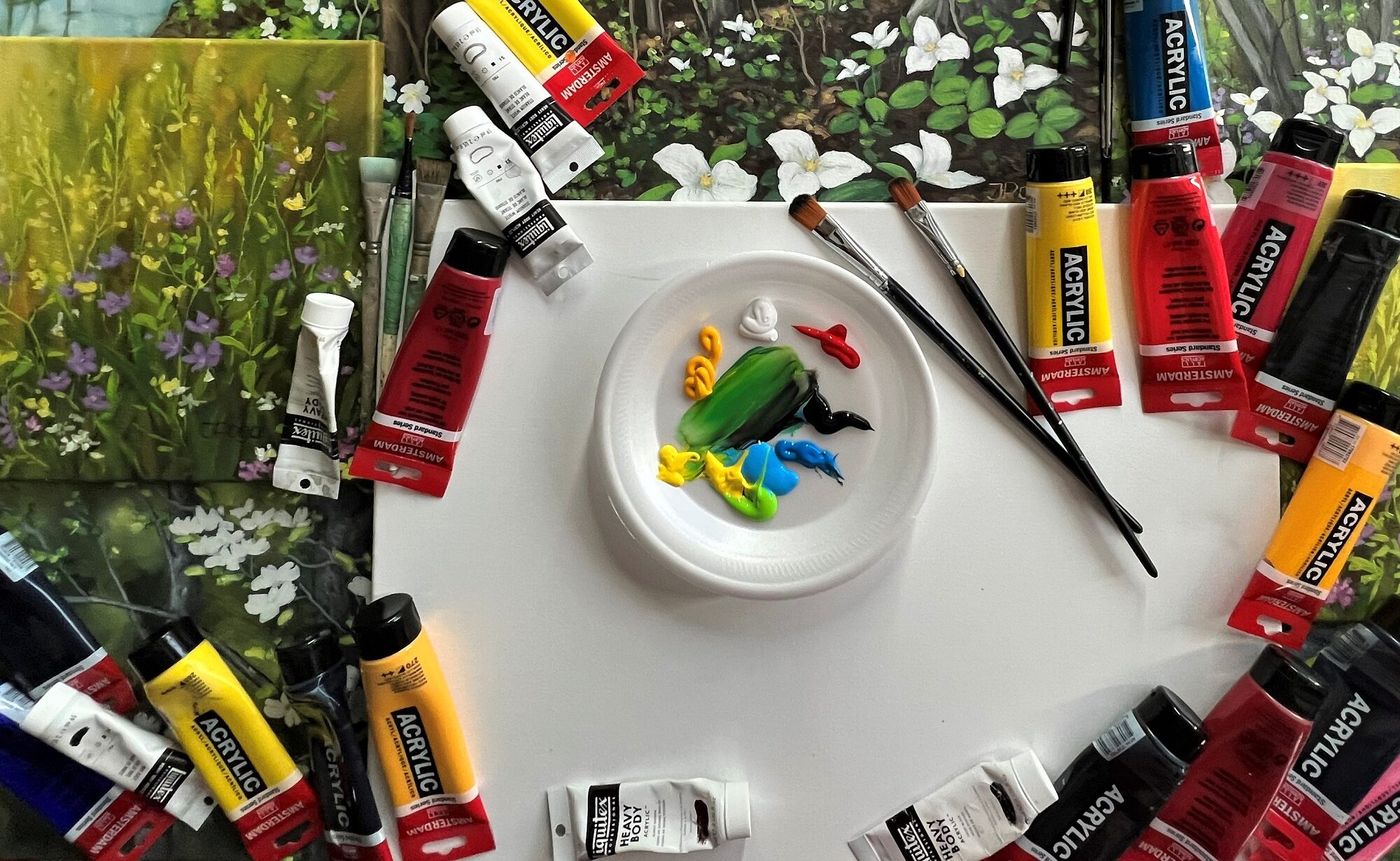
There is a principle which is always true when it comes to art supplies: the better quality art supplies are, the easier it is to apply them; and vice versa: the worse quality art supplies are, the more skills one will need to use them properly and to achieve good results.

How to or how not to

While many art instruction demos and videos are called “How to paint ….” they should be called, in fact, “How I paint ….” because there are lots of ways to interpret one and the same subject and one and the same theme. Many of demos also instead of “How to paint …” fall in the category “How not to paint …”. That’s just how wrong the demo or art instruction advice can be. With the widespread accessibility of internet and opportunity to share and post anything, we cannot be always sure if the advice we are given is correct or if it will ever work for us in particular. We have to approach everything selectively. That refers not only to art instruction, but also to any advice for any situation in life.

Teaching without skills? That happens

We have seen by now how art instruction is given by people who do not have the slightest teaching or art experience, as well. Art instruction has become an area where everybody is an expert. Would anybody teach and give music lessons? Piano or guitar lessons, for instance? No, they would not. Would anybody without any knowledge and skill teach foreign language, math or chemistry? No, they would not because that means misleading the student and pretending that one has what they do not. When it comes to drawing and painting, it is assumed that having no experience is not an issue. Just teach it and everything will be fine. Isn’t that a bit absurd?

Learn faster

I would say if you want to see fast results and create decent and interesting art, you definitely have to start with real and live art instruction. Let the art instructor see how and what you are doing because that is the only way to find out why some things do not work and what you should be doing to make this experience rewarding and uplifting. Realistically, the things one needs to learn are the main principles of drawing and painting, not the style and techniques of artist X, Y or Z.

Finding out what you can do

Once you have learned the basics and have established the foundation, you will be able to create anything, draw and paint anything in your personal style and develop a personal approach to any subject. That won’t limit you to being able to only paint one particular scene and subject. It will feel like: I can draw and paint any scene, any still life and floral composition. I can draw and paint anything. That’s why starting with techniques, values, color theory and composition is important. Practically, that means finding out what your brush, paint and pencil can do once you know how to use them.

From simple to complex

Therefore, I would suggest, we start with basics and go from simple subjects to very complex ones. Along with becoming skilled in art, drawing and painting are the absolutely best things to devote our free time and leisure hours to. This means also exploring ourselves, becoming smarter, better with decision-making and invisibly growing new brain cells, as well, extending the lifetime of the existing brain cells. That means a better memory and an improved cognitive function.

Suggestions on how to choose art classes: https://inesepogagallery.com/2017/10/09/choose-art-classes/

Registration for art classes: Art classes

And some of our previous experiences: https://inesepogagallery.com/2013/09/20/art-classes-a-worthwhile-activity/

Celebrate in style: the best way to get into Christmas mood

Christmas mood, small paintings

Robins, cardinals, fun and Christmas mood

Christmas mood must be intentionally created. Original art has a special attraction, energy and flare to it, therefore, it really helps. I don’t think there can be too much art on any walls. I have usually some 200 works of art on display in my studio gallery, and it does not feel overwhelming or crowded. I rotate my art depending on demand and season. It feels very appropriate to have snow scenes and winter villages on display when Christmas is around the corner, and it is very obvious that spring flowers blossom around the gallery in spring.

Fantastic small bird paintings

I have a special love to small birds. I preferred them to any other creatures already as a kid. I assume that one should only paint what they know. I watch these birds during any season, and I have hundreds of sketches which I can turn into artworks later. I painted this particular painting “Robins, winter” last year. I painted 6 bird paintings. As it frequently happens, I felt I wanted to improve the color balance. So, I added a few more layers of paint to this painting. I believe it became better and birds are more bird-like, as well. The entire scene is lovely and welcoming and speaks for itself – it works very well for Christmas mood.

Robins, winter, 16 x 20 in (41 cm x 51 cm) acrylic painting on canvas, sold

Festive gift painting workshop

I  invite everybody to participate in a festive workshop at the beginning of December to try out how nice of an adventure it is to create something heart-warming and cheerful. We can choose the image, and some people usually prefer winter scenes, some illustration or wall decoration type of art, as well as some might go for birds. We also paint poinsettias almost every winter. I must admit, that is a subject which always works well on canvas and paper and looks great.

Create the mood, create the gift

The best way to get into Christmas mood is to create art that suits the season. Let us celebrate in style with original art this year! Please let me know if you like “Robins, winter” painting and whether you’d love me to ship it to you!

Art prints and other artistic products are available from Fine Art America., just click on image.

My favorite from all products with this particular painting is the spiral notebook. It looks unbelievably good! Mugs also look impressive, so do actually lots of my art products and art prints.

Here is how you get to purchase many fantastic prints and similar artsy things at very attractive prices: Art collections by Inese Poga

Celebrate in style and have a wonderful Christmas mood!

Celebrate in style: art that suits any taste, first featured painting

Celebrate in style

Celebrate in style

Celebrate in style includes my creations which I will post as frequently as I can taking into account that every painting takes between 6-8 hours a day. I also create decorations for display at store front. Plenty of very attractive three-dimensional paintings and gift paintings are available every holiday season from my art studio.

Winter trees under snow: great subject

Such art can be a great gift or a fantastic decoration. Winter trees are so adorable, and when the first snow is falling  getting into the holiday and Christmas spirit is easy. Having this simple, yet beautiful tree on a wall is also a pleasure. I finished painting this tree image set and I could not stop enjoying and looking at it.

Idea and its implementation

The idea comes from the internet. I saw somebody had painted simple outlines and text on the wood, and I really liked the idea of creating such beautiful look. I just had to figure out how to achieve this without wood. I simply did not have any, especially suitable pieces. Well, I usually create what I do not have. The wood textures are painted on a regular canvas panel. This painting has  touchable and visible texture, it even feels like wood.

December painting workshops

We will have workshop on December 9th. If you are not that far and reside in Durham region, Ontario, you certainly could take part and paint something similar for your own pleasure. Please apply here:  Art classes

Rustic and cozy style

This time, I am featuring a rustic Christmas tree painting that goes well with rustic style. This painting is acrylic and texture medium on 20 x 16 in canvas (or 51 x 41 cm). The background imitates wood, and it is also painted around the edges, so it does not need any frame. Extra textured tree with beautiful snowflakes, I hope you love it!

Let us celebrate in style this year! It is nice to have something original on the wall. It is absolutely ok to create something when we cannot buy it. Enjoy and let me know if I can ship this wonderful rustic tree painting to you!

Different approach to art class: focus on relaxing and stress-free creativity

Watercolor paints

Creativity for an art class

As the fall of 2017 is approaching, my new art class focus on stress-free environment and creative techniques. Students can learn, paint and relax letting all concerns and problems go. The key to creativity is being relaxed and not expecting miracles, but creating them: one small miracle at a time. I noticed that some students were taking art classes way too seriously, and being worried does not allow achieving great results.

Forget concerns and technical perfection

I want this to be a welcoming stress-free environment for creation so that purely technical goals become secondary. Traditional art instruction pays too much attention to the technical execution leaving the emotional and mental side neglected. That is why some artists go for big lengths: trace and copy photos, repaint everything which is in digitally adjusted photo. What about creativity? Going for photographic perfection frequently lacks the emotional aspect. I’d like to emphasize: the creative process is the most valuable part of the artistic journey.

Don’t limit yourself

Perfection in art is not the best goal because it simply prevents from unfolding our creative potential and limits the range of tools and techniques we apply. I hear this quite frequently: I’m not touching this painting anymore because I do not want to damage it. Well, leaving work unfinished isn’t good either. Limitless creativity takes us much further. You will learn effortless and, thus, stress-free techniques to avoid leaving work unfinished in my art class.

Live versus online art class

I also wanted to make an art class which is impossible to replicate online. The content of this art class rests on the presence and the interaction between me, group and everybody as an individual. The live art class allows me seeing and noticing why something does not work and why students cannot achieve the result they are looking for.

Artistic experience

I will gear everything towards a great, interesting, amazing and positive experience. That means learning about oneself and art, and learning to be creative without the annoying pressure which some teaching venues want to impose on somebody who is looking for a new skill and ability.

Painted images diary

We will use blocks of paper, so that at the end of this  positive painting session  everybody will have an image diary and will be able to continue adding creations. Inspiration and immersion in calm, creative environment is what one can find engaging in art.

Emotional satisfaction

I believe, this type of art class where experience and activity flow together creating emotional satisfaction, thus, being stress-free and providing with a new perspective on the bothersome issues in one’s life, will be appreciated. It’s interesting that I was away and did not do any advertising so far, but people were applying already, in fact, a lot of people. That included the new daytime watercolor painting class.

Wash paintings without drawing

I am adding as illustration brushstroke and wash only painting. We use only watercolor paint and water, and we watch what happens and how our thoughts and ideas look on paper. Watercolor paintings without drawing:  it is fun, relaxing brushing and interesting flow of pigment:

Choose your own subject

Participants will have a lot of choice: they can draw, they can use pen or they can also do very abstract or semi-abstract art for their image diary. That’s why it’s called: stress relief with color and line. Art classes are for everybody because we will be using only our personal preferences with colors, subjects and the way they look.

Sign up here: Art classes

Find out more: Inese’s blog

Illustration or sketch: one, two, three: ready!

Barn illustration, art classes

Illustration or sketch of building

Illustration or sketch can be simplified in order to get it done outdoors or to complete indoors because sometimes the weather can be quite bothersome and not cooperating with our intentions. I would love to share some observations because they might inspire somebody to just get a pencil, a brush and paper and go ahead.

Do we need rules in art?

It might sound strange, but most people believe there are many strict rules when we draw or paint. Maybe the instruction on some sites makes one feel that if you do not follow these rules you cannot paint or draw. That is not true.  While there are lots of tricks, shortcuts and favorite ways to get things done faster and better, one should not try to stick to something which we call strict rules. Not with creativity. Not in art.

Learn freedom from children

That would mean the small kid who does not have an idea of rules and instructions should not be able to draw. But the small kid is able to draw. Every kid is able to draw and paint. As people grow up they find out that life wants us to comply with requirements, regulations, rules and certain instructions. It’s no surprise they want to apply rules to everything what we do. I know artists who would call every step of drawing or painting a rule.

No rules, but observe principles

I would love to encourage these who want to try art, to just go with their intention. I hear quite frequently: I don’t know anything about painting or drawing. Well, you don’t have to. You just have to start trusting your eyes and trying to draw or paint whatever you intend to. We discover all main principles of art along the way. These principles are composition, color theory and mixing, values, contrast, direction of light, shadows and perspective.

What to use for watercolor sketching?

You can use for sketching everything you can afford or like. If you do not know whether you will continue or not, why would you buy watercolor brush at $75? We always use the largest watercolor brush that still allows achieving what we want. It’s pretty much common sense. You could live with just one number 10 synthetic, soft watercolor brush if it has a good fine tip. 20-brush sets from Dollarama won’t do anything, don’t go for these.

Decent watercolor paper

If you are applying wet paint on your sketch, traditional sketching paper won’t allow that. It is too thin. That’s pretty much common sense, as well. It could tolerate dry pencil or some pen, but not washes, especially repeated washes or paint lifting. I would advise to always use watercolor paper for drawing, sketch, illustration, practice, color or flow practice because it is thicker and can be made wet. If you are a beginner, you can use just beginner’s watercolor paint set.

You can do illustration or sketch any way you like

If you are afraid to draw right away with pen, do the initial drawing in pencil and go over with pen afterwards. Keep the best lines and erase everything else, and there you have a nice, clean, attractive drawing. Why to use pen? It is simply easier. Pen makes the outline clearly visible, the entire image looks finished and elaborated even when the drawing is far from perfect, but watercolor washes will bring your artistic attempt to life.

There is no wrong or right way to sketch, to draw or to paint

All artists develop their own style over time. Should you expect the first attempts to be perfect? No, don’t do that. Always tell yourself: let us see what happens. Treat all of your first year’s art as practice, as experiment. Some will be god, some will fly into the wastebasket, and that is absolutely fine.

Artistic mistakes can be interesting

People call everything which did not come out perfect: a mistake. That does not always apply to art either. Some artistic mistakes and flaws can become the foundation of your personal style. Some experiments can set the tone for anything you do in the future. Therefore: experiment, experiment and experiment!

Use any style

Illustration or sketch can be carried out in any style you prefer. Illustration can be done easily. I am advising to use pen just for simplicity and speed. It really helps. I also love the accomplished look of such sketches which can be definitely used as completely finished art on the wall or for any other purpose.

A few steps

Barn illustration, step 1, pen drawing

First we draw with pencil the main lines. We draw lightly without using pressure. After that we repeat the best lines in pen.

Step 2, adding background color

Choose whatever colors you love and would want in your sketch. Activate with water. Test on testing paper how transparent the watered down mix is. Apply small amount of water onto the main image area. You can use spray bottle if it creates mist. Check against light: if the shine is about to disappear, that’s the best time for first washes.

Illustration is ready after adding more washes with less diluted paint

Adjust and correct

If you allow first layers to dry and then make your paper wet again, nothing will happen to the first dry layers. It is safe to go over with water. Don’t rub or scratch with the brush; that will definitely take off some paint. Corrections are done with paper towel when the painting is wet: pressing paper towel onto watercolor paper will take off most of wet paint. When paper is completely dry, apply washes and use damp brush or paper towel to lift color or remove paint. Repeat until you like it.

Large 18 x 24 in or 46 x 61 cm sketch, done in a few minutes for demo

Pen and paper

The thicker the watercolor paper, the more things you can do with it. Cheap watercolor paper is for tests and practice only. It is simply too thin to do something more. You can choose any pen you can afford or like. Your pen can be different color, too. Black simply fits any other color and makes it stand out more.

All watercolor illustrations and sketches look great. If you want them to be better, practice more and don’t expect immediate perfection.